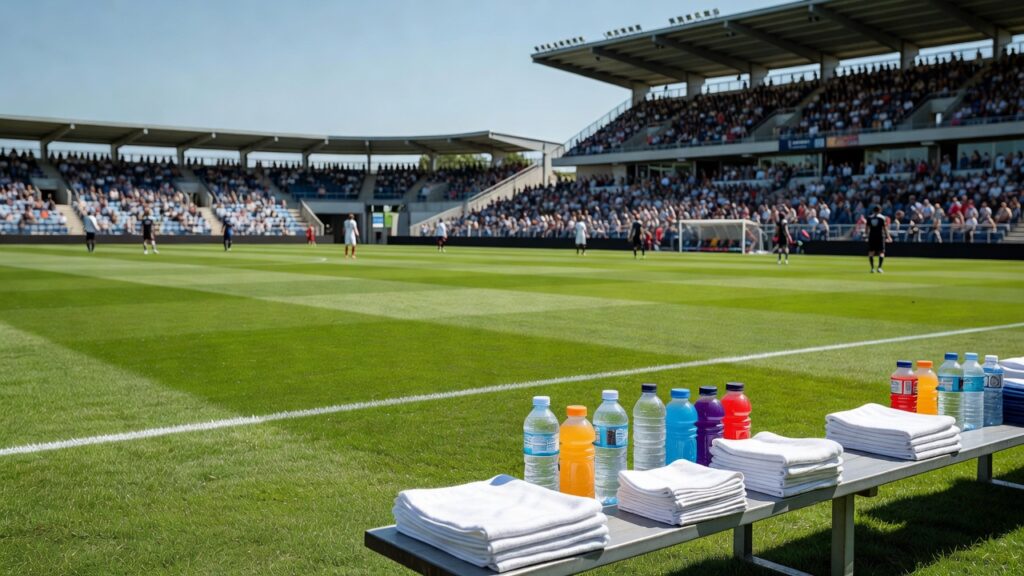
FIFA has required three-minute hydration breaks midway through each half in all 2026 World Cup matches regardless of temperature or venue conditions, marking the first such mandate in tournament history as the event co-hosted by the United States, Mexico and Canada opened amid warnings of extreme heat, an Associated Press report stated on June 18, 2026. The measure draws from the sweltering 2025 Club World Cup in the United States where temperatures frequently topped 90 degrees Fahrenheit and prompted player welfare concerns, according to FIFA’s December 2025 announcement. Critics from coaching circles and scientific communities have questioned whether the pauses truly suffice for cooling while arguing they interrupt match momentum and create opportunities for tactical instructions or broadcaster advertisements.
The Associated Press report detailed that the uniform breaks seek to ensure equal conditions across all 104 games as outlined by FIFA, which consulted with coaches and broadcasters before implementation. ESPN reported that the decision followed the prior summer’s Club World Cup experiences where oppressive heat and humidity raised alarms among participants and fans alike. A Reuters analysis on June 15, 2026, noted that players remain split with some viewing the stops as welcome relief and tactical tools while others see them as momentum killers.
Even elite athletes risk exertional heat illness when competing in hot and humid environments as the body’s core temperature rises and strains the heart, nerves, muscles and central nervous system, medical experts cited in the Associated Press report explained. Symptoms range from muscle cramps and fatigue to headache, nausea, dizziness and dehydration while temperatures exceeding 105 F can cause confusion, aggression or unconsciousness that signal exertional heat stroke, a leading cause of death in athletes, Yuri Hosokawa of Waseda University stated in an email. Hosokawa, who co-signed a May letter urging FIFA to extend cooling breaks to at least six minutes, emphasized the need for stricter guidelines to protect competitors.
Dehydration worsens the dangers since athletes can sweat one to two liters per hour yet typically replace far less, with a mere 2 percent body weight loss impairing physical performance, the Associated Press report continued. Ryan Calsbeek, a Dartmouth College biological sciences professor, described how the body functions better when warmer until a wet bulb globe temperature around 95 F at which point cooling mechanisms fail and performance drops sharply. “Your body starts to really fall apart, you lose the ability to cool off fast enough. And the physiological mechanisms just break down,” Calsbeek said.
The mandated three-minute pauses permit players and referees to rehydrate and apply cooling methods such as cold towels to the neck, head, back and arms though their impact depends on execution and individual tolerance, Douglas Casa of the University of Connecticut’s Korey Stringer Institute told the Associated Press. “Some people can tolerate a little more fluids comfortably and then do intense exercise. Some people can’t because it sloshes around in their stomach and they don’t feel super comfortable, so they might not drink as much in such a short period of time,” Casa added. He joined others in recommending five or six minutes to achieve more substantial temperature reductions of about 0.22 F per minute under optimal conditions.
Bharat Venkat, director of the Heat Lab at the University of California, Los Angeles, stressed that such breaks prove crucial to avoid forcing the body into constant recovery mode without respite, particularly as climate change intensifies heat challenges for all sports. An NPR study found more than a third of scheduled World Cup matches carry high risk of dangerously hot and humid conditions, multiple outlets including ESPN reported. FIFA chief tournament officer Manolo Zubiria confirmed in December 2025 that the breaks would apply universally irrespective of roofs, air conditioning or local weather to simplify enforcement.
Reuters noted that medical specialists broadly endorse hydration protocols yet many argue the current length falls short for meaningful physiological relief in extreme scenarios. Forbes analysis suggested the pauses, which segment each half, also open dedicated windows for television commercials after FIFA permitted broadcasters to sell advertising during them. Joshua L. DeVincenzo of Columbia University’s National Center for Disaster Preparedness described the breaks as a mitigation tool against potential emergencies, according to the Associated Press.