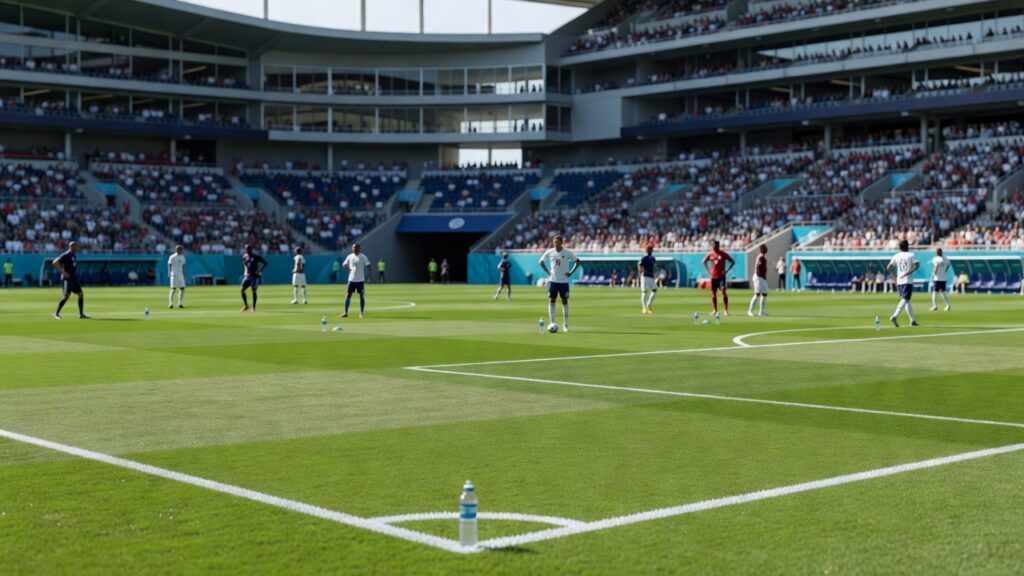
FIFA will review the mandatory hydration breaks introduced during all matches at the 2026 World Cup to decide on their future application, president Gianni Infantino indicated on June 24 as the tournament continues to produce record goal tallies alongside fan criticism of the stoppages. The pauses, occurring midway through each half regardless of venue conditions, have drawn jeers especially in air-conditioned stadiums but have coincided with sustained match intensity and standout performances from stars including Lionel Messi, Kylian Mbappe and Erling Haaland. Infantino defended the uniform policy as essential for fairness across the expanded 48-team competition.
The AP report from Atlanta quoted Infantino as saying FIFA would analyze future use “based on this experience.” He suggested the breaks allow coaches to reassess tactics while giving players time to recover and return at full speed. The president noted that matches have maintained unprecedented intensity with attacks continuing until the final seconds. This approach may have contributed to the entertainment levels seen so far in the United States-hosted event.
Criticism has centered on the breaks resembling commercial timeouts with loud boos greeting stoppages around the 22-minute mark of halves. Infantino stressed the importance of applying them universally to avoid any competitive imbalance. “If we were to use hydration breaks only in those matches where it was too hot and not in the other matches, we would give an advantage or a disadvantage to some of the coaches or some of the teams,” he said. He questioned why weather would dictate tactical opportunities for one side but not another in the interest of sporting equity.
The FIFA president also rejected claims of financial gain from the innovation. Broadcast contracts were signed well before the decision to implement the breaks across every fixture. “Broadcasters, maybe, they make, they generate more. I don’t know, that’s great for them,” Infantino stated. “But for us, we make zero additional revenues.”
FIFA guidelines have included hydration breaks since the 2014 World Cup in Brazil where they were deployed selectively during high-heat matches according to the organization’s medical assessments. Similar protocols appeared in Qatar in 2022 when environmental thresholds such as wet-bulb globe temperatures above certain levels triggered the pauses. The 2026 edition represents a departure by mandating them in all games including those in climate-controlled venues. This consistent application has now triggered the comprehensive review Infantino outlined.
The ongoing tournament has already exceeded expectations in entertainment value following the 2017 FIFA Congress decision to expand from 32 to 48 teams. Debutants such as Cape Verde and Curacao have delivered shocks while established sides produced high-scoring contests at a record pace. FIFA statistics from prior editions show the 2022 World Cup averaged 2.69 goals per game with the current competition surpassing that benchmark. The governing body will incorporate player welfare data fan feedback and match dynamics into its assessment ahead of the 2030 tournament.