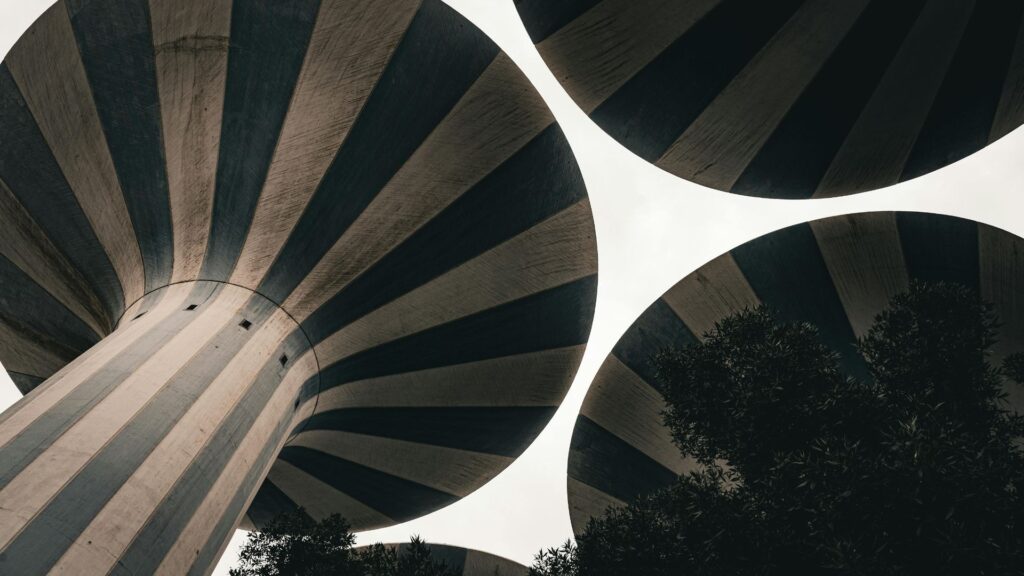
With their flared tops, bold stripes and three-million-litre tanks, Kuwait’s mushroom water towers brought a futuristic look to everyday infrastructure. Fifty years after their completion, the design still deserves a closer look.
Look up at Kuwait’s mushroom water towers and the space-age appeal is immediate. Slender concrete stems rise into enormous, flared tops, creating a silhouette that could sit comfortably in a vintage vision of the future. Then comes the detail that makes them even more impressive: each tower was designed to hold three million litres of water. That is the equivalent of six million half-litre bottles, stored high above the ground inside a structure that has become part of Kuwait’s architectural character.
Designed by Swedish architect Sune Lindström, the 31 mushroom towers are arranged in five groups and were completed in 1976. In 2026, their 50th anniversary year offers a fresh reason to look at these familiar forms and appreciate just how much engineering, design and ambition went into them.
Three million litres above the skyline
The story began in 1965, when Kuwait commissioned Swedish engineering firm VBB to develop a modern water-supply system. The mushroom towers brought substantial storage capacity to that programme, with each reinforced-concrete tank holding 3,000 cubic metres. Across 31 towers, that adds up to a designed capacity of 93 million litres. Raising water above ground also serves a practical purpose: elevation allows gravity to help create the pressure needed to move it through a distribution network.
The design makes that engineering visually compelling. A narrow support carries a much wider tank, giving each tower its distinctive top-heavy profile. Repeating the form across a group creates a rhythm of stems, curves and overlapping canopies, with the sky becoming part of the composition.
A look made for the camera
Each group has its own character, shaped by differences in number, height, colour and ornamentation. In the Aga Khan archive’s photograph of the striped towers, pale concrete and dark bands create a striking pattern against the blue sky. The stripes travel up the stems and fan across the undersides, drawing the eye towards the broad rims. Sunlight and shadow add another layer, giving the same repeated structure a different appearance from one tower to the next.
The mushroom towers also share a story with the waterfront Kuwait Towers. Both belonged to the wider water-storage programme, which provided more than 100,000 cubic metres of capacity across 33 water-storing towers. The project received the Aga Khan Award for Architecture in its 1978–1980 cycle.
That combination of useful engineering and confident design gives the towers their lasting appeal. They reward a second look: first for the silhouette, then for the scale of what sits inside. Three million litres per tower is quite a story for a familiar piece of the skyline.