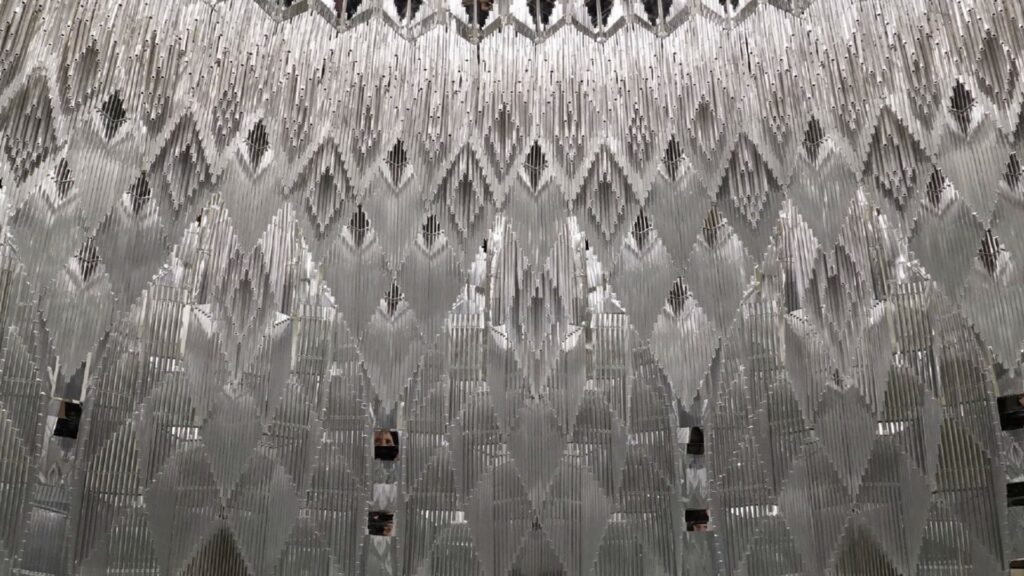
Kuwaiti designer Ghadeer Mohammed’s installation at Design Doha takes the patterns of traditional Bedouin weaving beyond the textile, using thousands of aluminium components to create an architectural interpretation of Kuwait’s living heritage.
Sadu patterns are usually encountered in woven fabric. In Ghadeer Mohammed’s latest exhibition, they become part of a structure that surrounds the viewer.
The Kuwaiti designer’s installation, The Muqarnas of Sadu, is showing in Doha’s Fereej Al Asmakh district. Presented by Al Sadu Society, it brings together the geometric language of Bedouin weaving and the layered forms associated with muqarnas in Islamic architecture.
According to the official Design Doha exhibition listing, the work comprises more than 4,000 aluminium pipes and 6,000 polished T-shaped connectors. It was originally conceived for the 2025 Sadu Art and Design Initiative and is now on display from November 5, 2026, to January 31, 2027.
The move from a textile surface to an architectural installation gives the project its central question: what happens when a familiar pattern becomes a place?
From woven pattern to architectural form
Muqarnas provides the installation’s underlying form, while Sadu motifs are arranged across it. Parametric modelling software helped translate those relationships into a structure whose reflections and shadows change as visitors move.
The material creates a deliberate departure from the wool and other animal fibres associated with traditional weaving. Aluminium catches and redirects light, making the repeated geometry visible through the relationship between solid components and open space.
Mohammed’s development process also involved direct engagement with the craft. In an October interview with Qatar Museums’ Q+A magazine, she described spending time with Sadu makers to understand their techniques and the meanings carried by their designs.
The interview identifies her as a master’s student in architecture at Kuwait University. It also explains a practical decision behind the original work: limited space at Sadu House meant choosing between reducing the installation’s scale and dividing the dome.
She chose a half dome, using a mirrored wall to suggest a complete form. That solution made the exhibition setting part of the design itself, rather than simply a room in which to place the finished object.
Mohammed used Grasshopper modelling software to explore configurations and prepare precise dimensions for fabrication. The process also allowed her to assess how changes to individual elements would affect costs, connecting the visual idea to the practical demands of making it.
A craft with knowledge behind its patterns
The installation draws on a tradition whose significance extends beyond its appearance. UNESCO describes traditional Al Sadu weaving as a craft practised by Bedouin women using a ground loom, with geometric patterns shaped by the desert environment.
Repetition and symmetry are fundamental to that visual language. They also connect the finished textile to accumulated knowledge about materials, technique and composition.
That context matters when Sadu enters a contemporary exhibition. A recognisable motif is only one part of the tradition. The person who knows how to produce it, and the process through which that knowledge passes to another maker, are equally important.
Mohammed’s project approaches the patterns through another discipline, architecture. It changes their material and scale while drawing attention to the geometric relationships that make them recognisable.
For an audience unfamiliar with weaving, the installation offers a different point of entry. Visitors encounter the pattern spatially before considering its textile origins. The exhibition can therefore be read as an interpretation of the craft, alongside the continuing work of teaching and practising weaving itself.
The Kuwaiti institution behind the work
The project emerged from an organisation that combines preservation with contemporary experimentation. Al Sadu Society describes its Sadu Art and Design Initiative, launched in 2016, as a platform for creatives to engage with Kuwait’s weaving heritage.
Its activities extend well beyond exhibitions. The society maintains a museum and research library, supports conservation of older textiles and runs programmes intended to pass weaving skills to new generations.
Sadu House itself became a home for weaving and textiles in 1980. That institutional setting helps explain how a project involving digital modelling and aluminium fabrication could develop through an organisation associated with traditional handwork.
The connection between established makers and contemporary designers is also becoming more urgent. Writing for the World Intellectual Property Organization in February 2025, society chair Sheikha Bibi Duaij Al Sabah said many of Kuwait’s expert weavers were in their eighties and that the society was documenting their knowledge.
Her account of the society’s work describes support for traditional textiles alongside contemporary applications. These activities place experimentation within a wider effort to retain the skills and records on which new interpretations depend.
Keeping the practice visible
Education provides another route for that knowledge to circulate. Al Sadu Society’s programme with Kuwait’s Ministry of Education trains art teachers to teach weaving, supported by instructional materials and exhibitions of students’ work.
UNESCO selected the initiative for its Register of Good Safeguarding Practices in 2022. Its programme record documented 30,959 student participants at that stage, alongside an initial group of 60 trained teachers who went on to train another 220.
Those figures describe a different kind of cultural transmission from an international exhibition: repeated teaching, classroom practice and the gradual acquisition of manual skills.
Mohammed’s installation adds a public architectural interpretation to that wider activity. Its presence in Doha brings a project developed through Kuwait’s Sadu initiative to an audience able to encounter the patterns at the scale of a room.
Until January 31, visitors to Fereej Al Asmakh can see that translation for themselves: a weaving tradition expressed through metal, light and space, with its origins still traceable to the knowledge of the makers at the loom.