A photograph can take a fraction of a second. For Kuwaiti astrophotographer Abdullah Al-Harbi, one image combined 44.5 hours of exposure, revealing distant clouds of gas that later appeared on NASA’s Astronomy Picture of the Day.
Abdullah Al-Harbi’s photographs take viewers far beyond the stars they can see above Kuwait. His subjects include the spiral arms of Andromeda, galaxies in the Virgo Cluster and the delicate outlines of nebulae formed around ageing stars. Several have appeared in NASA’s Astronomy Picture of the Day, where astronomical images are accompanied by explanations of the science behind them.
The photographs also provide a practical starting point for a question Al-Harbi has been bringing to students: how can someone on Earth use a camera to understand objects so far away?
In October, Kuwait University reported on a lecture he delivered during World Space Week, organised through its physics department in cooperation with the Kuwait Foundation for the Advancement of Sciences, the Kuwait National Center for Space Research and the university’s Physics Club. Its subject was astrophotography as a scientific tool, connecting the finished picture with the information contained in light.
A photograph built over many hours
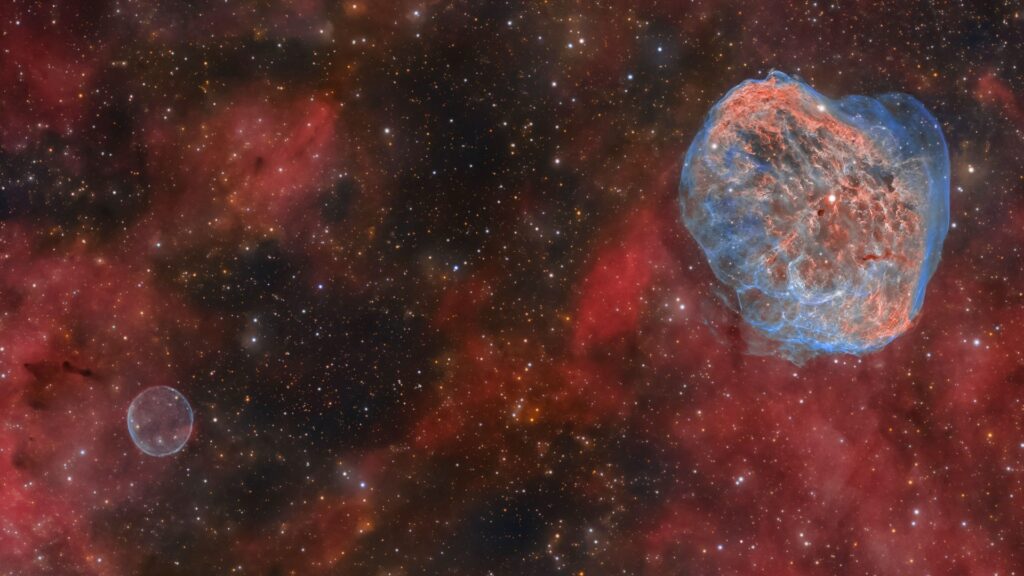
The time involved becomes clear in Al-Harbi’s published imaging records. His photograph of the Crescent and Soap Bubble nebulae lists 44 hours and 30 minutes of exposure. The Virgo Cluster image records 19.6 hours, while his Andromeda photograph lists 15.5 hours.
His equipment and exposure records describe combinations of telescopes, astronomical cameras and filters, alongside numerous individual exposures. The final pictures bring those observations together, rather than representing a single press of the shutter.
These records give viewers another way to read the images. Beside the colour and composition is a record of how much observing time went into making faint structures visible. Different targets also demand different commitments: his Witch Head Nebula photograph lists 11.5 hours of exposure.
Al-Harbi began astrophotography in 2020, having already spent years interested in photography. In a 2023 interview, he traced his interest in astronomy to a stargazing trip and described learning more about the sky before moving into photographing it.
He also described the practical constraints of working in Kuwait, including light pollution and hot summer nights. His account emphasised choosing equipment suited to the photographer’s environment. Those conditions form part of the work behind images that audiences encounter as finished views of space.
Andromeda, beyond a faint patch of sky
NASA featured Al-Harbi’s Andromeda Galaxy photograph on March 22, 2023. The image reveals a bright central region, winding dust lanes, blue spiral arms and red areas of emission within the galaxy.
Andromeda is more than two million light-years away. Under suitable conditions it can be seen without a telescope, but the naked eye sees little of the structure revealed in a detailed photograph. NASA’s accompanying explanation describes it as a faint cloud when viewed unaided.
That difference is central to the appeal of Al-Harbi’s work. The photograph gives shape and detail to an object that might otherwise pass unnoticed, allowing viewers to distinguish features within a galaxy beyond our own.
NASA’s explanation also places the image within a larger scientific history. Measurements of changing stars helped establish Andromeda’s great distance in the 1920s, demonstrating that it was a separate galaxy. A familiar name in the night sky became evidence that the universe extended far beyond the Milky Way.
Two nebulae, two different stellar endings
Another selection followed on September 4, 2023, when NASA published Al-Harbi’s Crescent and Soap Bubble image. The two objects appear in the direction of Cygnus, against a dense field of stars and glowing gas.
Their contrasting shapes reflect different stellar histories. The Crescent Nebula surrounds a massive star whose powerful wind has expelled material into space. The smaller Soap Bubble is described by NASA as likely being a planetary nebula, the expelled outer material of a lower-mass star approaching the end of its life.
NASA places both nebulae roughly 5,000 light-years away, with the Crescent spanning about 25 light-years. Their appearance in one frame offers a comparison between processes that unfold on scales far removed from everyday experience.
Al-Harbi’s Witch Head Nebula photograph, featured the following month, illustrates a different interaction between light and matter. NASA explains its blue appearance through illumination from the nearby star Rigel and the tendency of dust to scatter blue light more effectively than red. The colour is therefore part of the physical story of the object.
His Virgo Cluster photograph extends the view further still. Featured in May 2023, it shows galaxies approximately 50 million light-years away, including M87. NASA identifies that galaxy as the home of the supermassive black hole imaged by the Event Horizon Telescope.
Bringing the science back to students
The educational thread in Al-Harbi’s work was explicit in the Kuwait University lecture. The university’s account describes a discussion of how light carries information about celestial objects, including their temperature, composition and movement.
The session also covered cameras, filters and different wavelengths, alongside applications involving variable stars, solar activity, nebulae and interstellar dust. Citizen science formed part of the discussion, introducing ways students and enthusiasts can participate in collecting astronomical data.
This connects the images on NASA’s pages with a practical activity closer to home. A viewer can begin with the outline of a nebula, then ask what created it, why it has that colour and how its light was recorded.
For students encountering Al-Harbi’s work, the finished photograph is an introduction to those questions. His exposure records and teaching show the next stages: learning what to observe, understanding the equipment and interpreting the light that reaches the camera.