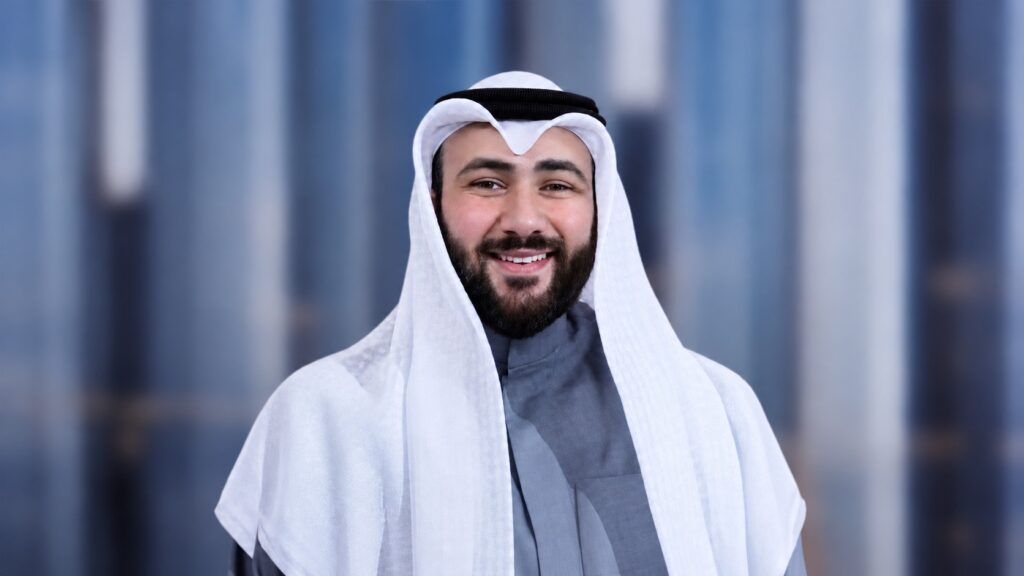
His appointment brings together a career spanning clinical practice, public health, entrepreneurship and consulting, with a stated ambition to bring international expertise into Kuwait.
Before Dr Bader Khraibut advised businesses on investment and strategy, he worked as a doctor in Kuwait. His subsequent career took him through public health, postgraduate study at Yale and healthcare entrepreneurship, before bringing him into the leadership of an international consulting firm’s Kuwait business.
Now appointed partner and managing director of Kearney Kuwait, Khraibut is taking on responsibility for the firm’s local growth, client relationships, delivery and talent development. The appointment, reported on 19 October, follows his tenure as Kuwait Market Leader at Strategy&.
In a conversation with Diwaniya Media, he described the move from medicine into business as a career pivot and spoke about bringing international expertise to Kuwait. His own route offers a specific way into that ambition: experience gained abroad, alongside earlier work inside the country’s healthcare system.
A career that crossed disciplines
Khraibut said he had lived in seven countries and spent part of his education in Dublin, including a period at the Royal College of Surgeons in Ireland. He later studied at Yale. His account was conversational rather than a formal career chronology, but the central transition was clear: he began as a medical doctor before moving into business.
That medical background extends beyond an academic qualification. A 2019 paper indexed by the US National Library of Medicine lists him as a co-author affiliated with the Kuwait Centre for Mental Health. Published in the American Journal of Therapeutics, the clinical case report places an earlier chapter of his work within Kuwait’s medical research community.
The research record adds a concrete dimension to the career change he described. Medicine was a field in which he practised and contributed to published work before his responsibilities expanded into business.
His experience abroad also emerged naturally during the call, through a discussion of studying in Ireland and the different countries in which he had lived. When asked to choose a favourite, he spoke instead about each place having its own charm.
From clinical work to public policy
A September 2022 profile published by the Yale School of Public Health documented Khraibut’s move from general practice at Kuwait’s Ministry of Health into the Public Health Administration shortly before the COVID-19 outbreak.
During the early pandemic, his work included contact with international counterparts and recommendations on public-health responses. He described collecting information through mobile surveillance teams and helping develop recommendations for senior government decision-makers.
The same Yale account records another transition. In December 2021, he co-founded Prophema Applied Research in New Haven with Canadian physician and regulatory-affairs specialist Rijul Puri. The venture sought to use technology and artificial intelligence in clinical-trial design and data collection.
Those were the company’s stated aims at the time, rather than independently established results. They nevertheless document his involvement in building a business around a practical healthcare problem, alongside studying how health organisations are managed.
Taken together, these stages show a career moving between service delivery, institutional decisions and enterprise. That history provides more substance to his new appointment than the medical title alone.
A wider mandate at Kearney
The appointment announcement describes experience spanning public institutions and private capital. Khraibut’s work has included establishing a public-sector entity, developing a healthcare investment strategy for a private-equity fund, conducting due diligence and supporting companies preparing for public listings.
His current remit extends across Kearney’s Kuwait business. Healthcare is one part of his background, while the country leadership position encompasses the practice’s wider client work and its people.
Kearney’s corporate profile places its presence across more than 40 countries. Khraibut’s emphasis in the call was on bringing international expertise into Kuwait, connecting the scale of the organisation with the market he now leads.
That distinction is relevant to the work of international consulting firms. Experience accumulated across countries becomes useful when it addresses the circumstances of a particular organisation: its people, its operating responsibilities and the decisions it needs to make. A global network supplies access to knowledge; its application remains a local task.
The local talent dimension
Talent development gives the appointment a wider Kuwaiti context. In its 2025 Article IV report, published in February 2026, the International Monetary Fund estimated that about 80 percent of employed Kuwaitis worked for the government. It also recorded a change in recruitment: in 2024, Kuwaitis filled more new private-sector jobs than public-sector jobs for the first time in a decade.
The report linked that shift partly to subdued government hiring and increased retirements. It did not mean the public sector had ceased to dominate national employment. It did, however, underline the importance of understanding what private-sector careers offer beyond the initial appointment.
In consulting, that includes exposure to different organisations and the opportunity to work through unfamiliar commercial and operational problems. Professional development happens through assignments as well as formal training, making the relationship between client work and staff development particularly close.
For Khraibut, the next stage brings those responsibilities together in Kuwait. Having moved between clinical practice, international study and business, he now leads a practice whose remit includes developing the people who will undertake its next generation of client work.