An unusually pale tree pipit photographed by Judeson Kochuparampan reveals a striking side of Kuwait’s birdlife, where a familiar migratory species can appear remarkably different.
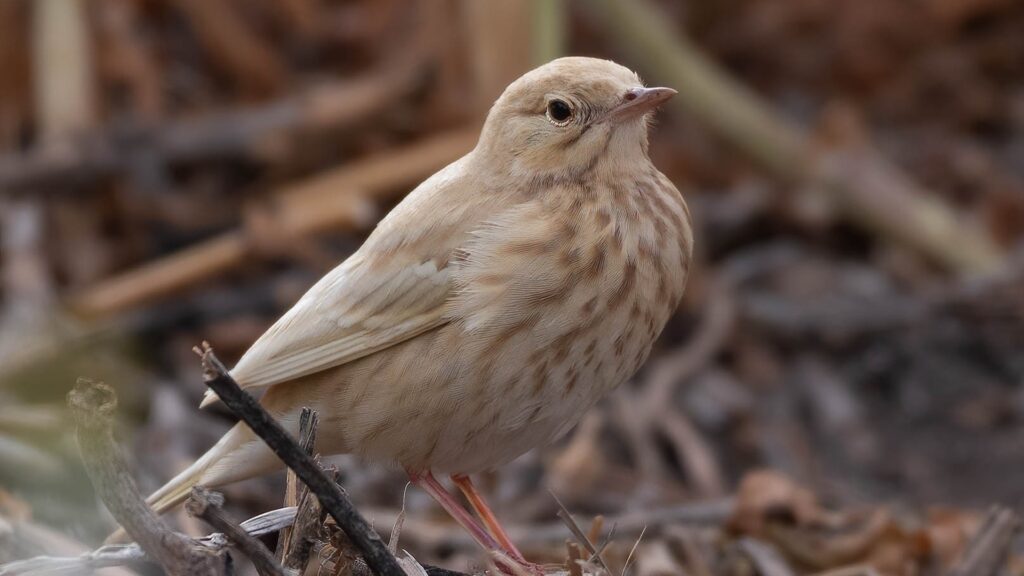
Photographer Judeson Kochuparampan has captured an unusually pale tree pipit in Kuwait, recording the bird’s cream-coloured feathers, delicate breast markings and dark eyes against a background of dry vegetation.
Kochuparampan described the bird as leucistic, a condition associated with the absence of pigment cells that can leave feathers partly or entirely white. His photograph offers a close view of the bird’s distinctive appearance, from the light feathers along its wings to the faint streaks still visible across its chest.
The encounter brings attention to one of Kuwait’s smaller seasonal visitors. While tree pipits are an established part of the country’s migratory birdlife, this individual’s pale plumage gives it a notably different appearance from the brown, streaked birds usually associated with the species.
A close encounter with Kuwait’s birdlife
In Kochuparampan’s photograph, the tree pipit stands among fallen twigs and dry leaves, its head turned slightly to one side. The close framing reveals individual feather patterns and subtle shades of cream and beige across its body.
Its dark eye contrasts with the pale feathers surrounding it, while the slender legs and pointed bill remain clearly visible. Along the breast and wings, traces of the bird’s usual markings give texture to its otherwise light appearance.
Kochuparampan shared the image as a memorable wildlife encounter, drawing attention to the unusual colouring he had observed. The photograph provides an opportunity to look closely at a small bird whose ordinary plumage can make it less conspicuous against grasses and soil.
Understanding the pale feathers
Feather colour is influenced by pigments, including melanin, which produces many of the darker shades seen in birds. Changes in the presence or distribution of these pigments can create striking variations within the same species.
The British Trust for Ornithology explains that leucism can affect all of a bird’s plumage or appear in individual areas. Birds may retain their normal eye colour even when some or all of their feathers are white.
This helps explain why a bird with unusually light feathers can still have prominent dark eyes. It also distinguishes leucism from albinism, which affects melanin production and can alter eye colour as well as plumage.
For a viewer encountering Kochuparampan’s image, the result is immediately noticeable: a bird with the proportions and fine markings of a pipit, but with a much paler overall appearance.
A seasonal visitor to Kuwait
The tree pipit, scientifically known as Anthus trivialis, belongs to the pipit and wagtail family and measures around 15 centimetres in length.
KuwaitBirds lists the species as a common passage migrant and a scarce winter visitor. During migration, tree pipits may occur in small flocks, feeding on insects among grasses and in agricultural areas.
Their recorded habitats in Kuwait range from Green Island to inland pools in Jahra and Al Abraq farther west. These locations illustrate the variety of settings in which the species can be encountered during its seasonal movements.
Beyond Kuwait, tree pipits breed across much of Europe and temperate parts of western and central Asia, travelling to Africa and southern Asia for winter. Their presence in the country forms part of that wider pattern of movement between breeding and wintering grounds.
The details that distinguish a tree pipit
Tree pipits normally have brown, streaked upperparts and paler underparts, with markings across the chest and flanks. Their appearance can resemble that of meadow pipits, another member of the same bird family.
The RSPB identifies several distinguishing features, including a heavier bill, a shorter hind claw and finer streaking along the flanks. The two species also have different calls, giving birdwatchers another way to distinguish them in the field.
Kochuparampan’s photograph brings several of these small physical details into view. Despite the unusual colouring, the pointed bill, slender shape and delicate feather markings remain visible.
The image offers a close portrait of an individual bird within Kuwait’s wider migratory landscape. Its pale feathers are the immediate attraction, but the finer details invite a longer look at a species that regularly passes through the country.