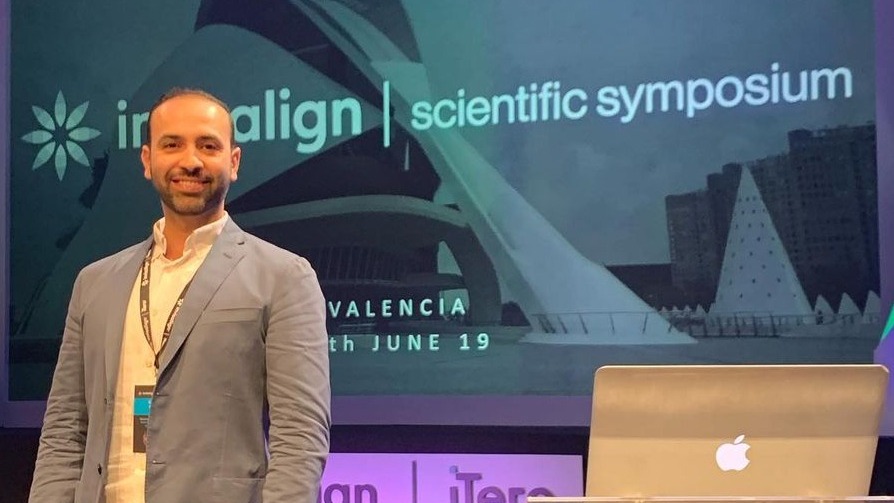
The Aline Dental co-founder’s contribution to an Elsevier atlas follows years of presenting treatment cases and teaching alongside international orthodontists.
Kuwaiti consultant orthodontist Dr Mubarak Al Saeed has contributed a treatment case to Atlas of Aligner Treatment and Planning: A Case-Based Approach, bringing his clinical work into an international reference for dentists. The contribution was announced in a post shared by Al Saeed and Aline Dental on 19 November.
Published by Elsevier and edited by Ravindra Nanda, Tommaso Castroflorio and Francesco Garino, the book examines how clinicians plan and carry out clear aligner treatment through individual cases. Al Saeed’s inclusion adds a publication milestone to a career that combines practice in Kuwait with professional teaching.
There is an earlier connection behind the announcement. In 2023, Al Saeed taught alongside Castroflorio and Garino at an Align Technology masterclass in Kuwait. Two of the clinicians with whom he shared that teaching programme are now editors of the reference featuring his work.
The Kuwait practice behind the contribution
Al Saeed is the chief executive and co-founder of Aline Dental Centers in Kuwait. His Saudi International Dental Conference profile identifies him as a consultant orthodontist who completed a master’s degree in clinical orthodontics at the University of Manchester and the MOrth qualification at the Royal College of Surgeons of Edinburgh.
That conference biography reports more than 5,000 Invisalign cases treated. The clear aligner system is also central to his work as an educator, linking the experience developed in clinical practice with the subjects he presents to fellow dentists.
On his official website, Al Saeed identifies himself as an Align Technology faculty member who teaches Invisalign treatment to dental professionals. Clinical practice and teaching were therefore established parts of his work before the new publication.
Aline Dental’s website lists locations at The Avenues and in Al Jahra. Those Kuwait practices provide the local setting for a professional profile that also appears on regional conference programmes and in international teaching activities.
An earlier connection with the book’s editors
The relationship between Al Saeed’s teaching and the atlas is visible in an account published by Align Technology in April 2023. The company described a two-day conference and masterclass in Kuwait involving Al Saeed, Garino and Castroflorio.
More than 25 doctors attended the sessions. The programme covered treatment planning, the mechanics of tooth movement, troubleshooting and completing treatment, as well as approaches to younger patients and particular bite problems.
The speakers also took part in a panel discussing their clinical experience with Invisalign and digital treatment tools. For participants, the event brought practitioners together to explain how they approached cases, including situations that required adjustments during treatment.
That history gives the book announcement a specific professional context. Al Saeed had already worked in the same educational setting as two of its editors, sharing clinical knowledge with dentists in Kuwait.
The atlas carries that case-focused approach into a published format. Elsevier describes a sequence that begins with assessment before treatment, follows the treatment itself and concludes with results and subsequent observations. Readers are given the stages of a case, allowing them to examine how the treatment unfolded.
Presenting treatment cases in Cannes
Al Saeed’s experience of presenting his work internationally also includes a case-presentation competition in Cannes. In a July 2024 post sharing his interview with Al Qabas, he reported winning first place in the French clear aligner society’s conference marathon, scoring 67 points out of 75.
He explained that shortlisted clinicians presented a treated case and described how they had approached it. Before-and-after records were shown to a panel of consultant judges as part of the assessment.
The format placed the treatment process at the centre of the presentation. Participants had to explain the case and the steps taken to reach the result, giving colleagues a basis for examining the clinical work.
In a separate video reflecting on the award, Al Saeed thanked his team, patients and supporters. He described the result as encouragement for young Kuwaitis and Arabs to compete internationally in their own fields.
The Cannes presentation and the Elsevier contribution belong to that same strand of his career: bringing individual treatment experiences before a professional audience. One took place in a conference competition; the other places a case within an edited reference that readers can consult beyond a single event.
From conference presentations to a published reference
That teaching work continued this month. In a post on 3 November, Al Saeed shared photographs from the Emirates and Gulf orthodontic conferences in Dubai and thanked the Emirates Orthodontic Society for inviting him.
He described presenting cases drawn from his experience with patients to an audience that included colleagues from the Gulf and further afield. His account also acknowledged the questions and discussions that followed, offering a recent example of how those clinical experiences enter professional exchange.
The new book contribution gives that work another setting. Elsevier identifies orthodontists and general dentists as the atlas’s intended readers, with approximately 3,300 photographs, radiographs and illustrations supporting its case-based material.
For Al Saeed, the publication extends an established progression from treating patients in Kuwait to discussing cases with colleagues abroad. His contribution now forms part of a reference organised around the decisions, stages and follow-up that make a treatment case useful to other clinicians.