Founded in 2013, Qout Market has extended its community of farmers and food producers into a dedicated craft and design fair, reflecting demand for space among Kuwait’s independent makers.
Qout Market’s expansion into a separate craft and design fair began with a practical problem: more makers wanted space in its seasonal market. The organisers’ answer was to give that part of the community an event of its own, launching a two-night Ramadan fair at the Sheikh Jaber Al-Ahmad Cultural Centre in March 2025.
That development adds another chapter to a Kuwait initiative that began in 2013 around food, farming and the idea of spending a Saturday together outdoors. Its evolution now spans both the produce stall and the design table, bringing different kinds of independent work into a shared public setting.
With another cooler season approaching, Qout’s history offers a useful way to understand what these markets contribute to Kuwait’s cultural calendar. Behind the weekend outing is a recurring question: where do small producers, craftspeople and designers meet the people who might buy their work?
A market built around the people making things
Co-founders Noaf Hussein and Budour Al-Qassar launched Qout after identifying local farmers, food enthusiasts and craftspeople who needed a place to come together. A 2015 account of its early development described the first market in November 2013 as having fewer than 20 stalls, followed by rapid expansion and a move onto the roof of a multistorey car park.
The same account traced two early extensions beyond shopping. Nourish offered a week of free workshops in October 2014, covering subjects from nutrition and food photography to crafts and kitchen skills. FarmTable organised visits to local farms, combining a tour with food and a small market. Both drew on the knowledge already present among Qout’s vendors.
Those initiatives help explain the breadth of the original idea. The market supplied a place to sell, while the workshops and farm visits gave the public ways to understand how products were grown or made. Education and social activity were part of the project early in its development.
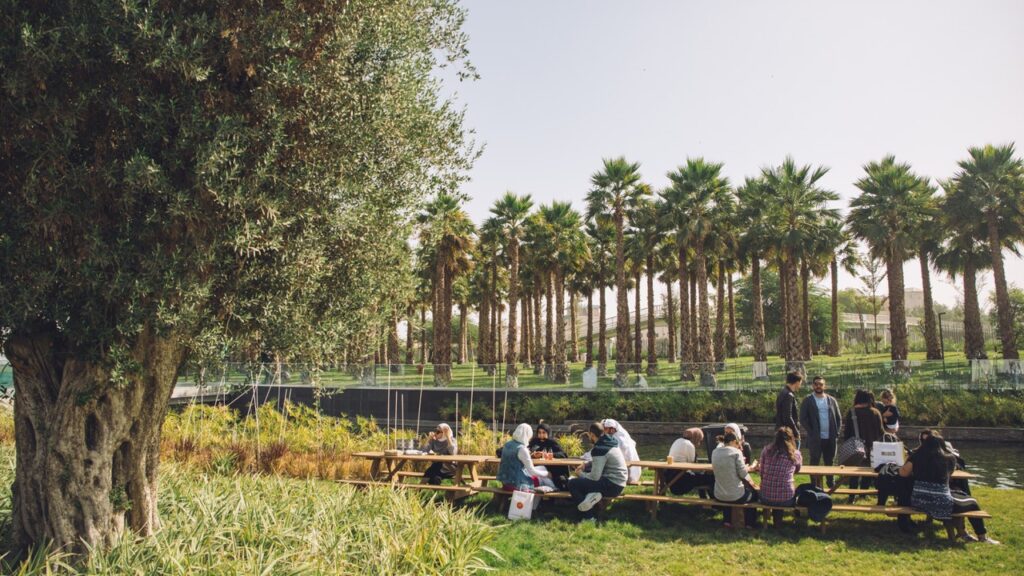
Its continuity was interrupted by the pandemic. When Kuwait Times reported its return in February 2023, the market was reopening after a two-year break, with visitors gathering in the gardens of the Sheikh Jaber Al-Ahmad Cultural Centre. The founders described an ambition that combined support for businesses with a family day out.
Design gets a separate space
The craft fair introduced in Ramadan 2025 brought art, ceramics, furniture, crafts and objects into a distinct evening format. Qout says it created the event because demand for places in the main market’s craft section was increasing.
The timing changed the setting as well as the programme. While the main market is a daytime event, the first design fair ran over two Ramadan nights at JACC, with light refreshments alongside the makers. This gave the craft section its own identity within Qout’s wider activities.
The organiser’s explanation is specific to its own applications and available space. It offers evidence of demand among makers seeking to participate, rather than a measurement of Kuwait’s entire design sector. Even within that scope, the decision is significant: a category that had shared the market with food and farm produce became the basis for another event.
The rules behind the stalls
Qout’s published participation terms show how deliberately the market is assembled. Applicants are assessed on their concept, products, presentation and contribution to the overall mix. The rules favour a local alternative over a franchise and limit vendors to the goods and brand approved during selection.
Business owners must remain present throughout the market to sell and interact with customers. That requirement puts the person responsible for a business within reach of the people browsing its stall, making direct exchange part of the event’s operating structure.
Participation also has costs and conditions. A non-refundable KD10 application fee is separate from the participation fee and does not guarantee acceptance. Food vendors must provide the commercial and food-health licences specified by the organisers. These requirements matter when describing Qout as a route for small businesses: access is selected and organised, with obligations attached.
The result is a market whose character depends on decisions made before opening day, from the balance of vendors to the commitment expected from each owner.
A place on Kuwait’s seasonal calendar
More recent reporting shows the scale of that gathering. Al Rai’s coverage of the December 2025 season opening recorded more than 100 participating projects at the Sheikh Abdullah Al Salem Cultural Centre, spanning food, organic agriculture and handmade work.
That report places the market in a cultural venue as well as a commercial setting. It also shows the range contained within one event: farm products and prepared food alongside items made by hand. For visitors, those categories occupy the same outing; for participants, they represent different kinds of small enterprise sharing a temporary sales space.
As of 6 October 2026, the season information available on Qout’s website still refers to 2025–26. A new opening date should therefore be distinguished from the market’s established pattern of cooler-month Saturdays. The next season’s venue, dates and participating makers remain details for the organisers to confirm.
What is already documented is the expansion of the format itself. Qout began by assembling producers for a seasonal market, added ways to learn from them, and later created a separate fair when its craft section drew greater demand. Its next calendar will show how those activities fit together in the coming season.