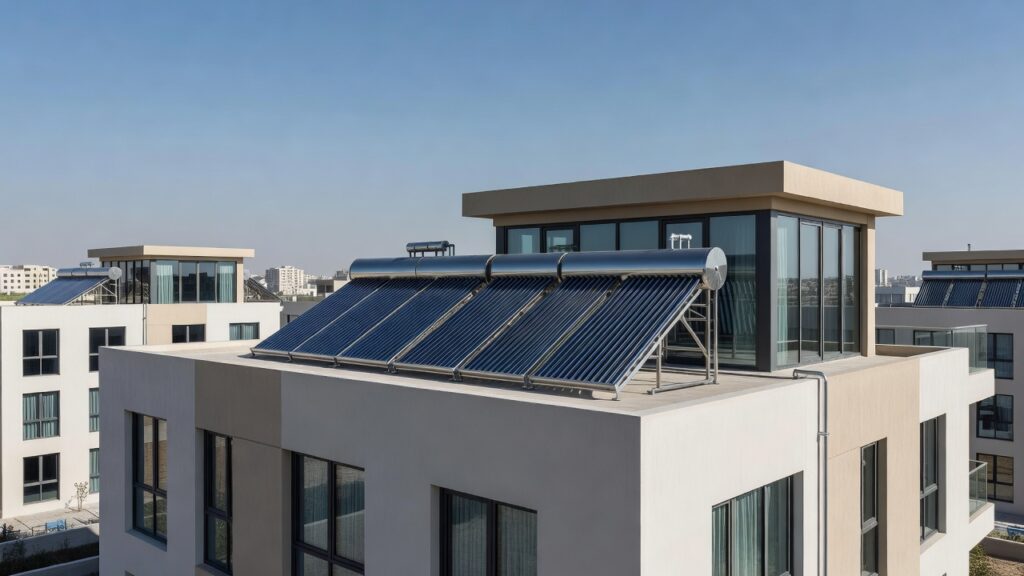
According to Times Kuwait, the Minister of Electricity, Water and Renewable Energy, Dr. Subaih Al-Mukhaizeem, issued the ministerial decision that establishes minimum technical standards for the design and installation of water heating systems. The requirements apply to new buildings as well as any expansions that increase electrical load, with the goal of improving energy efficiency while optimizing hot water use across both residential and non-residential properties. International Energy Agency data places Kuwait fifth globally in per capita electricity consumption at roughly 15.7 megawatt hours per person each year, underscoring the need for such measures in a country where buildings drive much of demand.
The regulation requires non-residential buildings to install systems capable of achieving at least 60 percent savings in total water heating demand, a step that directly supports broader national energy conservation objectives. Residential properties gain flexibility to choose among compliant high-efficiency technologies, including solar water heaters and heat pump systems, as long as they satisfy the efficiency criteria. A modeling study in the journal Energies found that electricity serves as the sole fuel for water heating in Kuwaiti homes, where unit consumption depends on factors such as daily hot water volume and heater energy factors that range from 0.90 for standard models to 0.95 for high-efficiency units.
The decision extends earlier building energy conservation codes that the ministry has updated over the past decade with progressively stricter rules for new and retrofitted structures. Kuwait Institute for Scientific Research figures within the Kuwait Energy Outlook project that renewables should supply 15 percent of the country’s electricity by 2030, a target the new water heater standards will help advance by lowering overall demand. Public Authority for Industry notifications to the World Trade Organization have similarly introduced Kuwaiti Standard KWS 1903:2025, which sets minimum energy performance requirements and labeling for water heaters entering the market from November 2026 onward.
Residential buildings currently account for nearly 60 percent of national electrical power generation, according to research from University College London that examined villa and apartment consumption patterns. Within homes, air conditioning accounts for about 67 percent of electricity use while water heating and appliances make up the balance, creating multiple avenues for efficiency gains. The new code therefore forms one element of a wider strategy that includes pricing reforms and promotion of green technologies to manage peak loads that have grown steadily in recent years.
Implementation will shape permitting and design processes for upcoming construction projects as Kuwait pursues economic diversification away from oil reliance. The ministry has emphasized uniform application of the standards to ensure consistent outcomes in both government and private developments. A 2021 analysis by the Kuwait Institute for Scientific Research highlighted that without accelerated efficiency policies, domestic consumption could outpace production capacity and hinder export goals by the mid-2030s.