From carrying water and building wooden ships to preparing cotton bedding and supplying bread, familiar Kuwaiti surnames preserve connections to the work that sustained the country’s earlier generations. But the meaning of a name is only the beginning of a family’s story.
A water carrier, a shipwright, a cotton worker and a baker: behind four familiar Kuwaiti surnames are words connected to the everyday needs of an earlier Kuwait. Al-Kandari, Al-Qallaf, Al-Qattan and Al-Khabbaz offer a way into that history, bringing attention to the people who supplied homes, equipped boats and kept neighbourhoods functioning.
Their significance goes beyond a literal translation. A trade could become an identifying name and remain with later generations long after the original work had changed. In other cases, a family’s explanation of its name involves commerce, a particular ancestor or an act remembered by the community.
That distinction matters when turning a surname into a historical account. Explaining the occupation associated with a word does not establish the ancestry of everyone who carries it. Family testimony and documentary evidence can reveal a more specific story than a short definition allows.
## Family names have more than one starting point
Kuwait University researcher Amin Almuhanna’s study, [On the Origin of Kuwaiti Surnames](https://pure.ku.edu.kw/en/publications/on-the-origin-of-kuwaiti-surnames/), published in 2023, examined a corpus of 670 surnames. It traced their origins to five components of older Arabic naming traditions: given names, names formed through parenthood, patronymics, relational names and nicknames.
The research provides a broader framework for understanding names that may otherwise appear to be straightforward descriptions. Some refer to people or relationships; others preserve associations with places or identifying characteristics. Occupational names belong within this wider history, rather than explaining Kuwaiti surnames as a whole.
For readers investigating their own name, the useful distinction is between the history of the word and the history of the family. The first can suggest where to begin. The second requires evidence about particular people, places and generations.
## Al-Kandari: the work of bringing water home
Al-Kandari is associated with the water carriers who used a kandar, a pole carried across the shoulders with containers suspended at either end. The equipment made it possible to carry water through streets and deliver it to households.
The work belonged to a much wider system of obtaining and distributing fresh water. Before modern supply networks, Kuwait depended on sources including wells, collected rainwater and water transported by sea. A [historical account of Kuwait’s water supply](https://kuwaittimes.com/article/30803/lifestyle/how-kuwait-quenched-its-thirst/) describes the kandar alongside other delivery methods, including leather water containers transported on animals.
The name therefore points towards a practical part of urban history: getting water from its source to the people who needed it. Securing a supply and delivering it were separate tasks, and both required labour.
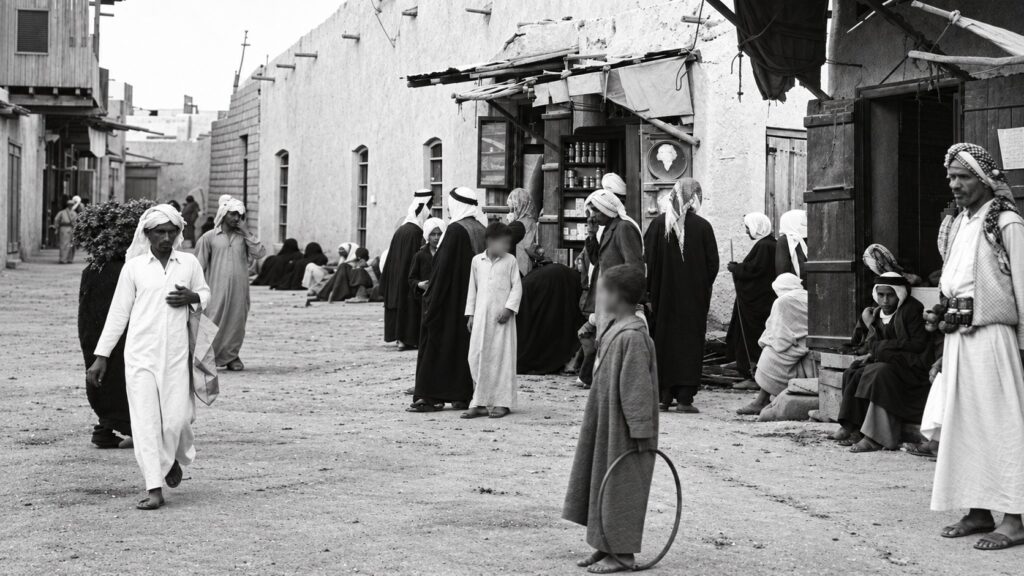
Remembering the occupation also changes how an old street photograph can be read. A pole and two containers were working equipment, connected to a service that households depended upon. The surname preserves an association with that work even where the equipment is no longer familiar.
## Al-Qallaf: the craft behind Kuwait’s wooden ships
Al-Qallaf connects to qalafa, the craft of building wooden vessels. The plural, qalalif, refers to the craftsmen whose work supported Kuwait’s maritime economy.
A [KUNA account of traditional shipbuilding](https://www.kuna.net.kw/ArticleDetails.aspx?id=2472798&language=ar) describes an organised craft involving specialist workers, selected timber and materials sourced through regional trading connections. Merchants and captains commissioned vessels, while an experienced master oversaw their construction.
The craft brought together different kinds of work. Timber had to be shaped and fitted, iron nails secured the structure, and cotton fibres helped seal the gaps between planks. The finished vessel depended on the coordination of these materials and skills.
That makes Al-Qallaf more than a general reference to working at sea. The occupational meaning concerns making the vessels themselves. It directs attention from the voyage to the workshop, and from the captain to the craftsmen whose work made the journey possible.
The distinction is useful when discussing maritime heritage. Sailing, trading, fishing and shipbuilding were connected activities, but they were not interchangeable occupations.
## Al-Qattan: cotton work inside the household economy
Al-Qattan is linked to cotton, with Kuwaiti family accounts providing detail about how that association developed through work.
In a [2010 interview with Al-Anba](https://www.alanba.com.kw/111329), Abbas Al-Qattan described his family’s involvement in cotton carding and the production of mattresses, pillows and quilts. He recalled his father inheriting the occupation and working on bedding supplied to institutions including the army and the American Hospital.
The account places cotton work within both household life and a wider commercial network. Cotton was imported from India, prepared locally and made into finished products. It was skilled processing and manufacturing, rather than simply the sale of a raw material.
Abbas also described changes in equipment, including machines imported to prepare cotton. His recollections show a trade adapting over time, even while the family name retained its connection to the material.
This is where a family interview adds something a dictionary cannot. “Cotton worker” supplies a meaning; remembered workplaces, customers and tools explain how the occupation was actually practised.
## Al-Khabbaz: a bread connection with a fuller family story
Khabbaz means baker, but a family account can reveal a more particular route from bread to surname.
In a [2010 Al-Anba interview](https://www.alanba.com.kw/137607), Murtadha Al-Khabbaz connected his family’s name to an ancestor involved in supplying grain and distributing bread. He recalled a story in which that ancestor brought wheat by ship during a shortage and worked with bakers, while also providing bread to people in need.
The account should be understood as that family’s explanation, rather than a universal history of everyone named Al-Khabbaz. Its value lies precisely in the detail: the association with bread involved supply, trade and distribution, not merely a job title.
Taken together, these names lead into different parts of Kuwait’s working past. Water carriers served homes, shipwrights equipped maritime activity, cotton workers made bedding, and bread suppliers connected grain shipments to daily food.
They also point to the evidence needed to take the story further. A family name can open the question; an interview, an old document or a record of a workshop can help explain whose story it actually tells.