With 196 countries on his published tally, Yousef Alrashed’s journeys through Baghdad, Socotra and Somalia show how travel can bring unfamiliar places and their people closer to audiences in Kuwait.
Yousef Alrashed’s Instagram biography lists 196 countries visited out of a personal target of 197. For the Kuwaiti traveller known online as @yalrashid, that figure brings a longstanding ambition close to completion. Along the way, he has built a collection of travel accounts that invite viewers to look more closely at places they may know mainly through the news.
His published introductions connect that ambition with a clear purpose: to challenge negative impressions through encounters with countries and their people. Baghdad, Socotra and Somalia offer three different examples. One brings a Kuwaiti visitor into contact with a neighbouring society; another introduces an extraordinary natural environment; the third involves returning to a country he had already visited.
Together, those journeys raise a question that matters beyond travel itself: how much of our understanding of a place comes from seeing everyday life there, and how much comes from the reputation that arrives before it?
Baghdad through a Kuwaiti visitor’s eyes
In April 2019, Alrashed published the first instalment of his Baghdad trip on YouTube, drawing on his Snapchat coverage. In the accompanying description, he said he had enjoyed the visit and was struck by the mistaken impression many people held of Iraqis. His message to viewers placed the relationship between the two populations at the centre of the account.
“Kuwaitis and Iraqis are loved ones, brothers and family,” he wrote in Arabic. He thanked viewers for their comments and described the journey as part of his wider effort to show a positive side of the countries he visited, also naming Eritrea and Afghanistan among his examples.
That emphasis gave the Baghdad account a particular relevance for audiences at home. A Kuwaiti visitor was describing his own reception in a neighbouring country and inviting others to reconsider their assumptions about its people. His nationality was part of the conversation, including in the message of familiarity and affection he addressed to viewers.
Publishing the footage on YouTube also allowed the trip to remain available after its original Snapchat coverage. The first Baghdad instalment has attracted more than one million views, giving a personal account of the city an audience far beyond the people who initially followed the journey.
Socotra and the places a country’s reputation can obscure
Alrashed’s Socotra series took that approach into a different setting. Published in several parts in 2020, it introduced the Yemeni island through its scenery and the welcome he received. In the description of the second episode, he linked that hospitality to experiences he had previously had in Iraq and Syria, making the people he met a recurring part of the story.
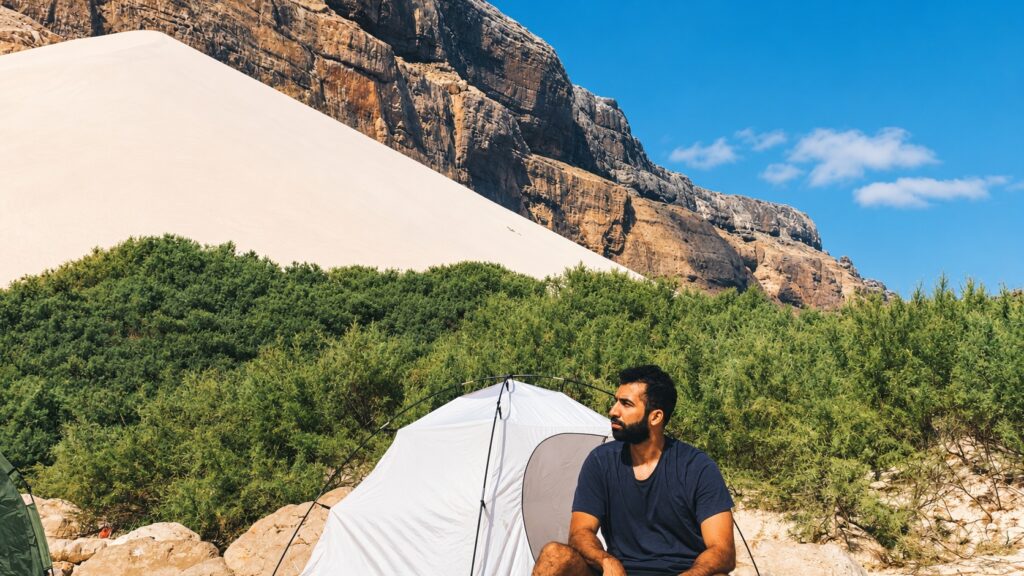
By the fourth instalment, published in June, he was drawing attention to the island’s natural beauty, birds and residents. “Tourism there supports its people,” he wrote in Arabic, explaining why he wanted viewers to give Socotra attention. The photograph accompanying that episode showed him beside a tent, with vegetation, a pale sand dune and cliffs filling the landscape behind him.
In comments reported by Al-Mahriya, Alrashed also described the gap between researching Socotra online and experiencing it in person. He said he had spent a week on the island and spoke about its unusual trees, birds and encounters with dolphins. His account conveyed the surprise of finding so much that the images he had seen beforehand had not fully communicated.
The island’s natural importance is independently documented. UNESCO inscribed the Socotra Archipelago on its World Heritage List in 2008. Its assessment records that 37% of the archipelago’s 825 plant species, 90% of its reptile species and 95% of its land-snail species occur nowhere else in the world.
That context gives the travel coverage another dimension. A viewer drawn in by striking scenery is encountering a place of exceptional scientific importance. UNESCO also identifies unsustainable tourism among the potential threats to the archipelago, connecting the appeal of visiting with the responsibility to protect what makes it distinctive.
Recognition for a Kuwaiti voice in travel
Alrashed’s work had received regional recognition before the Socotra series appeared. In 2019, he won the award for best tourism content on Snapchat from the Arab Centre for Tourism Media. Contemporary coverage of the ceremony in Cairo named Yousef Khaled Alrashed among the winners, alongside journalists, broadcasters and other travel-content producers from across the Arab world.
The category connects directly with the way he documented Baghdad. Snapchat allowed audiences to follow a journey in instalments, while YouTube gave the material a longer life. His work across those platforms created both an immediate account of travelling and a record that viewers could return to years later.
His travel experience has also been discussed on Kuwait Television, including an appearance on Kuwait Today in August 2022. Those appearances brought the subject into a domestic television conversation about travel and exploration, extending it beyond the audiences following his own accounts.
The significance of going back
His account of Somalia adds another dimension to the journey. In a public exchange in May 2026, Alrashed described being on his third visit, thanking Hiba Shookari for her welcome. Shookari had praised his coverage for combining social and cultural observations with humour and for offering a different perspective on the country.
A third visit provides an opportunity to encounter a place again, with the experience of earlier journeys behind it. For Alrashed, returning to Somalia sits alongside the ambition to reach destinations he has never seen. Both are part of the travel record he shares with his audience.
His published tally leaves one destination on his stated list of 197. The journeys already documented contain their own reasons to keep watching: the reception of a Kuwaiti visitor in Baghdad, the extraordinary environment of Socotra and the people who welcomed him back to Somalia.