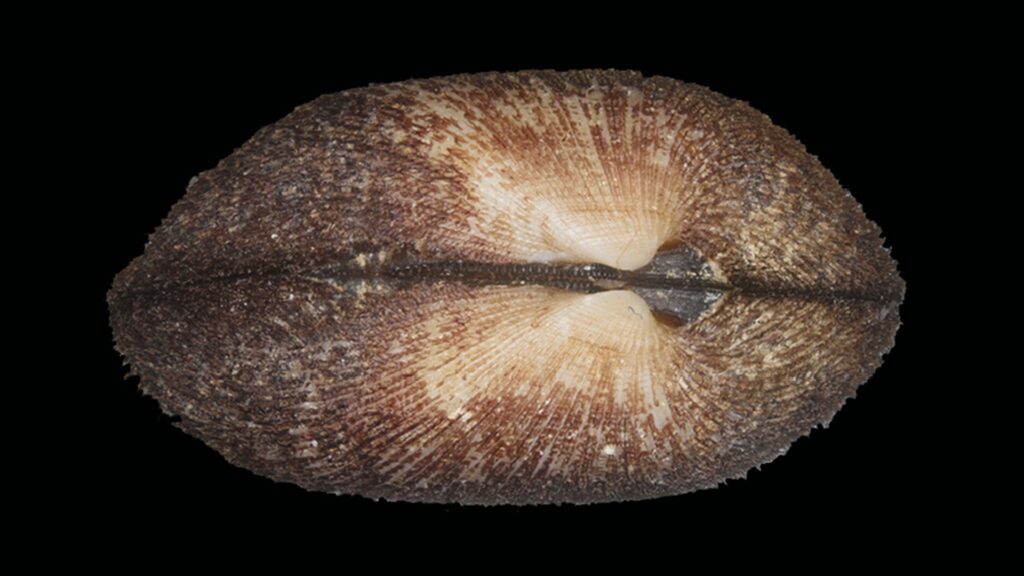
Research co-authored by KISR’s Dr Manal Al-Kandari has identified a distinct shellfish species named after bajila, adding to a wider effort to document the marine life along Kuwait’s shores.
Bajila has found an unexpected place in Kuwait’s scientific record. A small shellfish from the country’s shores has been named Didimacar bajelaopsis because its rounded brown shell resembles the familiar bean, giving a newly described marine species a distinctly local identity.
Behind the name is research co-authored by Dr Manal Al-Kandari of the Kuwait Institute for Scientific Research (KISR), alongside P. Graham Oliver, Matteo Garzia and Daniele Salvi. Their study, published in Zoosystematics and Evolution on 29 October, combines detailed examination of the animal with DNA evidence to establish it as a distinct species.
The discovery also revisits decades of records. This shellfish had already been collected and documented in Kuwait under other scientific names. Recognising its identity required researchers to return to the shoreline, collect fresh material and test an assumption that appearance alone could not settle.
From Kuwait’s shores to the laboratory
The animal is small, rarely exceeding 15 millimetres in length, and lives beneath rocks and stones in the area covered and exposed by the tides. It attaches itself with fine threads and is often found in muddy or silty surroundings. These are accessible coastal habitats, yet the identities of some of their inhabitants remain unresolved.
Al-Kandari and her team collected specimens for DNA analysis between 2024 and 2026. Samples used in the study came from locations including Auha Island, Al-Judailiat, Sharq and Belajat Beach in Salmiya. The principal reference specimen, known as the holotype, was collected by Al-Kandari at Al-Judailiat in April 2025.
Her contribution extended from organising the project to field collecting and isolating tissue for analysis. Oliver examined shell structure, anatomy and classification, while Garzia and Salvi carried out the DNA sequencing and molecular analysis. The work linked KISR with the National Museum of Wales and Italy’s University of L’Aquila, bringing local collections together with specialist examination and international comparisons.
What the DNA revealed
The team examined a short genetic sequence commonly used to help identify animals, a technique known as DNA barcoding. Nine sequences from the Kuwaiti specimens formed a distinct group when compared with available records for similar shellfish. The closest database match shared only 82.5% identity across the sequence compared, indicating substantial genetic separation.
That percentage concerns the particular DNA region tested, rather than the animals’ entire genomes. Alongside the examination of their shells and anatomy, it provided evidence for recognising the Kuwaiti specimens separately. The study illustrates why a familiar-looking shell can still present a difficult scientific question.
Shell shape was especially challenging because the animal changes as it grows. Larger specimens become more rounded, while details such as the number of ribs also vary with size. Comparisons based on a handful of shells can therefore be misleading. DNA added a line of evidence that visual inspection alone could not provide.
The researchers also set out what remains unresolved. More genetic material from the Philippines, where the previously named species was originally described, and from other populations would help clarify relationships across its reported range. Establishing the Kuwaiti species is part of that wider effort to check how reliably existing names describe marine life.
A wider record of discovery
The bajila-named shellfish belongs to a longer programme of documenting Kuwait’s coastal animals. An illustrated checklist published in 2023 by Oliver, Al-Kandari, Manaf Behbehani and Henk Dekker brought together the country’s intertidal bivalves, the group of molluscs with two hinged shells. It was designed as a reference for both biologists and people interested in collecting and identifying shells.
That publication drew on KISR surveys and subsequent collecting, while acknowledging that further work was needed before a definitive atlas could be produced. Earlier guides either covered only part of Kuwait’s molluscan life or used classifications that had become outdated. The checklist made existing knowledge more accessible while identifying questions that still required investigation.
Another answer arrived in October through a separate study co-authored by Al-Kandari describing Anadara adiastola. In that case, researchers had previously lacked suitable living material for DNA analysis. Targeted collecting supplied specimens from Al-Judailiat, Shuwaikh and Miscan Island, allowing the team to examine genetic evidence alongside shell structure and anatomy.
Together, these studies show the value of returning to unresolved specimens. A collection can establish that an animal occurs in Kuwait while leaving its precise identity uncertain. Further fieldwork and laboratory analysis can turn that incomplete record into a description other researchers can examine and use.
Building a clearer map of marine life
The next stage extends beyond individual discoveries. Al-Kandari is listed as principal investigator of a project supported by the Kuwait Foundation for the Advancement of Sciences that uses DNA barcoding to resolve uncertainties among selected marine bivalves. Its published timetable runs from September 2024 to April 2027.
The project aims to clarify species identities, compare Kuwait’s animals with those recorded elsewhere and develop a comprehensive identification guide to common intertidal bivalves and their distribution. Its starting material includes collections from an earlier survey that identified 271 mollusc species, providing a substantial foundation for closer investigation.
Accurate identification is central to the project’s planned biodiversity inventory for Kuwait and the wider Gulf. For students and environmental researchers, a usable guide would connect a name with the features and locations needed to recognise an animal reliably. The bajila discovery supplies one more resolved entry in that work, with a reference specimen, published evidence and a name rooted in Kuwait.