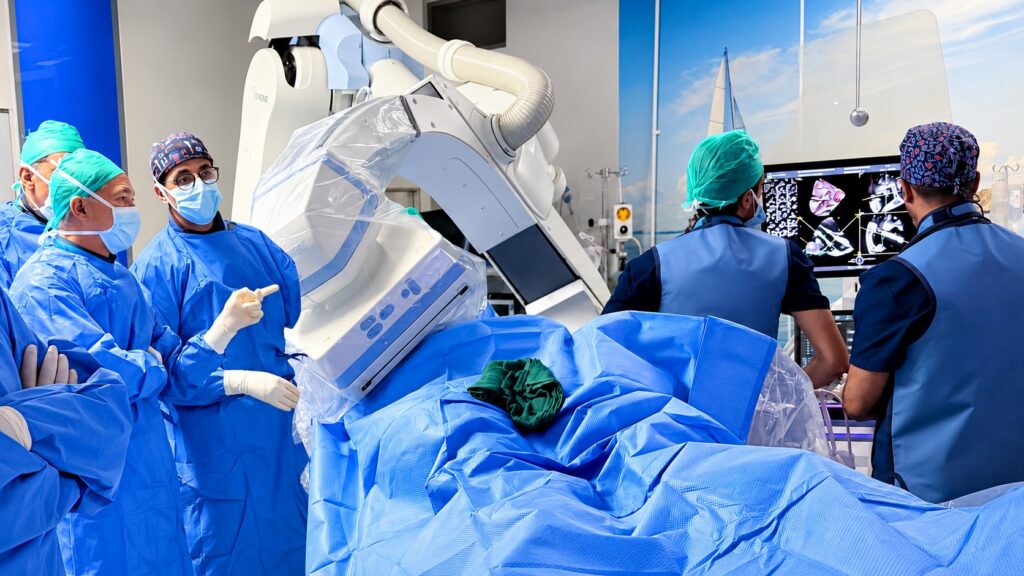
Dr Al-Tayeb Al-Qallaf and his colleagues have launched a new valve-replacement programme at Al-Adan Hospital, with its first two patients discharged the following morning.
Two Kuwaiti women left Al-Adan Hospital the morning after doctors implanted replacement heart valves through an opening in the neck no larger than 1cm, according to the Ministry of Health. Both were discharged in stable condition, with the ministry reporting an improvement in heart function.
The procedures marked the launch of a transcatheter tricuspid valve replacement programme at the hospital’s Salman Al-Dabbous Heart Centre. Led by Dr Al-Tayeb Al-Qallaf, the team used the LuX-Valve Plus system, reaching the heart through the jugular vein.
Announced on 25 October, the development concerns a valve on the right side of the heart whose failure can affect circulation well beyond the chest. The two patients, both in their late sixties, had severe valve leakage and early liver fibrosis, according to Al Rai’s account of the ministry’s announcement.
The doctors behind the procedures
Dr Al-Qallaf, a consultant in valvular and structural heart disease, worked alongside Dr Ali Al-Humaidan, a consultant in cardiology and echocardiography, Dr Ibrahim Hussein Arzoun, a cardiology specialist, and Dr Mohammad Abdulshafi. The programme launched alongside a specialist workshop.
The ministry also credited the anaesthesia and intensive care teams, and the heads of the departments involved, including cardiology department head Dr Bader Al-Ayyad, Dr Huda Al-Foudari and Dr Mohammad Shamsah.
That combination of specialties is significant in a procedure that depends on seeing, positioning and assessing an implanted valve inside a beating heart. International guidance places multidisciplinary assessment and advanced cardiac imaging at the centre of treatment decisions for complex valve disease.
The new programme sits within an established cardiac service. The centre’s website dates its establishment to 2009 and lists dedicated services for advanced valve and structural heart disease, cardiac imaging, catheterisation and open-heart surgery. Its stated remit includes patients in the Al-Ahmadi health region and elsewhere in Kuwait.
Why a leaking valve can affect the liver
The tricuspid valve sits between the heart’s right upper and lower chambers. It helps keep blood moving forward as the right ventricle pumps towards the lungs. When the valve fails to close properly, some blood travels backwards into the right atrium, a condition known as tricuspid regurgitation.
As the American Heart Association explains, this backward flow can increase pressure in the heart and nearby blood vessels. Blood backing up in the veins can contribute to swelling in the legs or abdomen and enlargement of the liver. Fatigue and weakness can also occur.
Symptoms may be absent or difficult to recognise early on. Treatment therefore depends on the severity of the leak, its cause and the effects on the patient, rather than the presence of a single symptom.
The report of early liver fibrosis in the two Kuwaiti patients gives the announcement a more specific clinical context. They were being treated for severe valve disease with an additional organ complication, rather than an incidental finding on a scan. The public announcement did not provide detailed measurements of their liver or cardiac function.
Reaching the heart through the neck
In a transcatheter procedure, clinicians deliver the valve using a catheter rather than implanting it through a conventional open-heart operation. For the two procedures at Al-Adan, the access route was the jugular vein in the neck.
The 1cm measurement describes the access opening reported by the ministry. The implanted valve and the work needed to position it inside the heart are separate from that small external entry point.
Published research on the LuX-Valve Plus describes implantation under X-ray and echocardiographic guidance. In an international registry, patients underwent detailed ultrasound assessment and cardiac CT planning before a multidisciplinary heart team selected the treatment.
That registry, published in JACC: Cardiovascular Interventions in 2024, included 76 patients treated at 15 centres between January 2022 and February 2024. Their median age was 78. At one month, 95% of assessed patients had tricuspid regurgitation graded moderate or less.
The findings provide context for the technology’s clinical development. The study was a retrospective compassionate-use registry, however, rather than a randomised comparison with surgery or medication. It also reported complications, including four conversions to surgery. Its results should not be read as a forecast for every patient treated in Kuwait.
A programme beyond the first two patients
The launch comes as international practice gives greater attention to catheter-based treatment of severe tricuspid disease. The European Society of Cardiology’s summary of its 2025 joint guidelines with the European Association for Cardio-Thoracic Surgery identifies a role for transcatheter treatment in high-risk patients with severe, symptomatic tricuspid regurgitation.
The intended benefits include improved quality of life and favourable changes in the right ventricle. Selecting an appropriate treatment still requires assessment of the patient’s condition and anatomy. A catheter procedure is one option within that decision, alongside medical treatment and surgery.
For the Al-Adan programme, the immediate reported outcome is clear: two women underwent implantation and returned home the following morning. That is an early recovery milestone. Longer follow-up will be needed to establish how their symptoms, valve function and wider health change over time.
Clinical reviews also emphasise repeated echocardiographic assessment after tricuspid intervention, including monitoring right-heart function and pulmonary pressures. Those later measurements help distinguish a successful implantation from a sustained improvement in a patient’s health.
The next chapter for Dr Al-Qallaf and his colleagues will therefore be measured beyond the procedure room: in follow-up scans, symptom assessments and the experience of subsequent patients entering the programme.