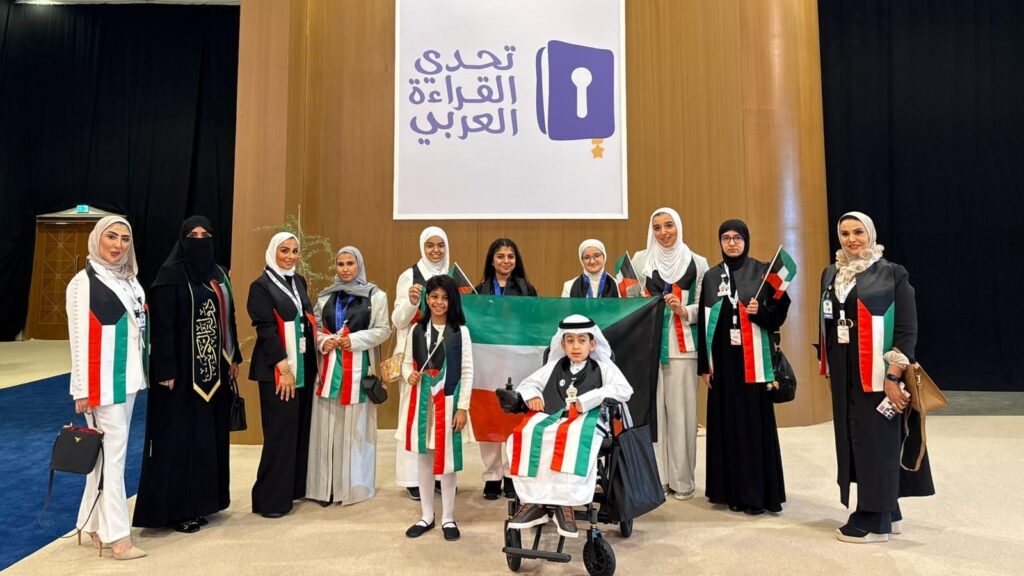
Yarmouk Secondary School for Girls has placed third in the Arab Reading Challenge’s outstanding-school category, bringing attention to the schools, teachers and learning environments behind Kuwait’s young readers.
A school award puts a whole learning community in the spotlight. For Kuwait’s Yarmouk Secondary School for Girls, third place in the outstanding-school category of the 10th Arab Reading Challenge recognises participation in a competition that gives institutions and educators a place alongside individual readers.
The result, announced by Kuwait’s Ministry of Education on 29 October, formed part of a wider Kuwaiti achievement. Budoor Al-Asqa took second place in the outstanding-supervisor category, Abdullah Al-Mutairi placed fourth in the people of determination category, and Nour Al-Kandari finished among the top 10 outstanding students.
Together, the results offer several ways to understand the country’s participation: through a school, an educator and two young readers. They also bring a practical educational question into view. What does it take to give reading a sustained place in school life, beyond the books students must study for examinations?
A competition built around sustained reading
The Arab Reading Challenge asks participants to undertake a programme of reading and summarising books outside their prescribed curriculum. Its published framework divides that work into stages, making progress visible across an academic year.
Under the organiser’s reading-passport system, students register through their schools and supervisors. They begin with a red passport, recording a summary for each of 10 books, before progressing through green, blue, silver and gold passports. Completing the five stages means reading and summarising 50 books.
The structure gives the challenge a particular educational character. Reading is followed by an account of what the student has understood, requiring the participant to return to a book’s content and decide what belongs in a concise summary. The task therefore extends beyond keeping a list of completed titles.
Schools and supervisors are embedded in that process from registration onwards. Their separate award categories recognise that participation has an institutional dimension, as well as an individual one. Yarmouk’s result belongs specifically to the school category, rather than representing an overall ranking of schools across every aspect of education.
Kuwait’s place in a wider Arabic reading initiative
The competition has developed substantially since its launch in 2015. Ahead of this year’s final, an official Dubai announcement described participation involving 40 million students across 60 countries.
The same announcement named Yarmouk among the schools competing for the Best School title, alongside institutions from countries including Morocco, Qatar, Egypt, Palestine, Bahrain and Saudi Arabia. Kuwait’s student and supervisor representatives also appeared on the published shortlists.
Those figures describe the reach of the overall initiative, rather than the number of direct competitors in Yarmouk’s final category. They nevertheless place the school’s recognition within a programme that connects local school activity to a much wider Arabic-language reading community.
For participating students, the progression from school-based reading to national selection and international recognition makes an activity usually associated with classrooms and libraries publicly visible. The final celebrates readers, while the work leading to it is organised through schools and the educators supporting them.
A school’s learning environment comes into focus
Yarmouk’s recent history provides another point of interest beyond the award itself. In December 2024, the Ministry of Education documented the school’s “Innovation and Application” forum, which presented initiatives involving students, teachers and the physical learning environment.
At that event, school principal Noha Bin Salama described three areas of emphasis: the learner, the teacher and the educational setting. The ministry’s account also recorded participation by parents and support from Dr Ghassan Al-Othman, founder of the nonprofit Athar community organisation.
One project discussed was the school’s Yarmouk Oasis garden. According to the account, the area incorporated the canteen, library and mosque, with temperatures measured to assess its use during the school day.
That earlier initiative provides concrete context for the school’s attention to its surroundings. It does not establish which activities contributed to the reading award or how judges assessed Yarmouk’s entry. It does, however, show that the institution’s publicly documented work has included questions about where students learn and how school spaces are used.
The library’s inclusion in that project is particularly relevant to a story about reading: it places access to books within a broader discussion of the everyday school environment.
Reading beyond the competition
The award also arrives alongside wider work on reading comprehension in Kuwait’s education system. On 28 October, the ministry reported training for Arabic and English subject supervisors as part of preparations associated with the Progress in International Reading Literacy Study, known as PIRLS.
The session addressed understanding and analysing texts, extracting information, drawing inferences and connecting ideas. It also introduced an electronic training platform intended to familiarise educators with the digital assessment environment and support monitoring of learners’ performance.
PIRLS has a different purpose and age focus from a reading competition. The International Association for the Evaluation of Educational Achievement describes it as an assessment of fourth-grade reading achievement, conducted every five years to provide internationally comparable evidence for teaching and learning.
The distinction matters: competition results celebrate particular achievements, while assessment examines reading performance through a separate framework. Both draw attention to understanding what is read.
For Yarmouk, the immediate achievement is specific and substantial: third place in a regional school-award category. The next chapter worth documenting is equally concrete: the books students chose, the activities teachers organised and the practices the school intends to carry into its next year of reading.