An exhibition of childhood memories, imagined worlds and women’s stories brings the Kuwaiti artist back to a venue that hosted her work in 1994.
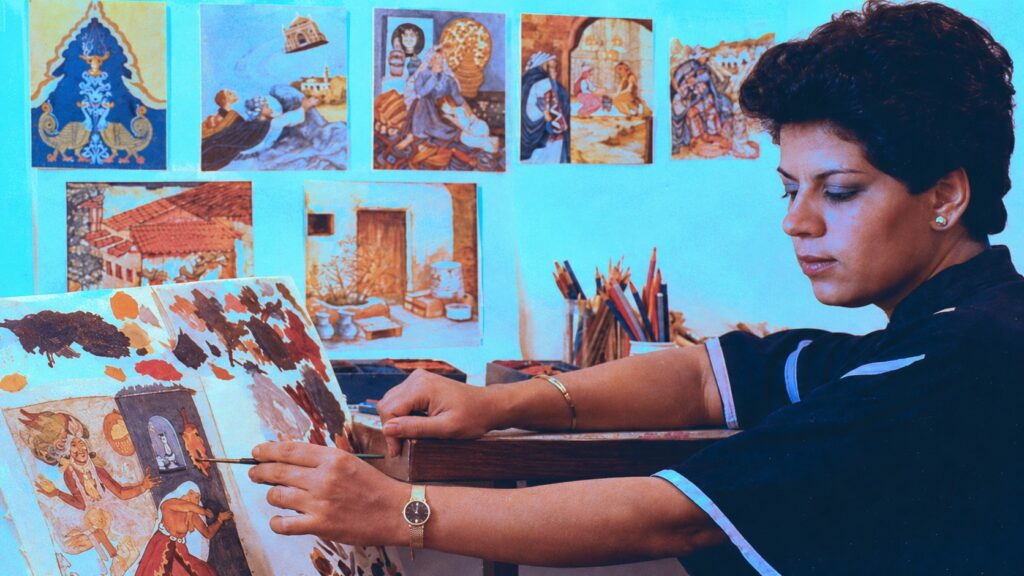
Thirty-two years after exhibiting at Bahrain’s Art Centre, Kuwaiti artist and writer Thuraya Al-Baqsami has returned with “Ribbons of Joy”, her 65th solo exhibition. Opened on 1 November, the show brings together painting and printmaking from a career in which personal memories and the experiences of Kuwait repeatedly find their way into images.
Organised by the Bahrain Authority for Culture and Antiquities, the exhibition runs until 29 November. Its focus, according to Bahrain Tourism’s official listing, is the relationship between memory and imagination: childhood experiences reworked into visual stories about humanity and identity.
For Kuwaiti audiences, the return offers a way to revisit an artist whose public life has unfolded across literature and visual art. Al-Baqsami began publishing and exhibiting as a teenager in the 1960s. Her subsequent work has moved between countries, languages and artistic techniques, while retaining subjects rooted in lived experience.
Returning to a familiar venue
The Art Centre first hosted Al-Baqsami’s work in 1994, two years after the venue officially opened. Her return connects the current exhibition with an earlier period of cultural exchange between Kuwait and Bahrain, giving the show a history beyond its place on this month’s events calendar.
Coverage of the opening describes a selection spanning acrylic painting and handmade prints, with works reflecting different stages of her practice. That range matters for an artist whose career cannot be understood through painting alone. Printed images, illustrations and written stories have developed alongside her canvases.
The opening was attended by Bahrain Authority for Culture and Antiquities president Sheikh Khalifa bin Ahmed Al Khalifa and Kuwait’s ambassador to Bahrain, Jassem Al-Najem. An accompanying artist discussion was scheduled for 2 November, extending the programme beyond the exhibition itself to the experiences behind the work.
In comments reported by KUNA, Al-Baqsami emphasised the importance of contact between Gulf artists and continued cultural exchange. Her return to the same venue gives that exchange a specific timescale: a relationship renewed more than three decades after her earlier appearance.
How childhood became an artistic language
“Ribbons of Joy” draws on childhood without presenting memory as a straightforward record. Its stated premise is the transformation of remembered images and details through imagination, allowing familiar experiences to take on symbolic forms.
That relationship between stories and pictures has a long history in Al-Baqsami’s practice. Mathaf’s account of her career traces her early interest in illustrated Arabic comics, fiction and poetry, followed by her own writing for local publications. Reading and looking developed together.
Her education later gave that connection a technical foundation. After studying in Cairo, she continued at Moscow’s Surikov institute, concentrating on graphic art and book illustration. Her graduation project involved illustrations for “Aladdin’s Magic Lamp”, bringing literary narrative and visual interpretation into the same work.
Time spent in Africa introduced further materials and methods. In Dakar, she developed her experience of silkscreen, batik and painting on silk. Mathaf connects these experiments with the outlines and figurative compositions that became characteristic of her work.
These experiences help explain why an exhibition about childhood can encompass several artistic approaches. Memory supplies the subject, while an education across different places provides the means of reshaping it.
Women, history and the written word
Women occupy a central narrative position in the exhibition’s introductory material. That emphasis belongs to a wider body of work in which female figures appear across personal, social and imagined settings.
The Sharjah Art Foundation’s profile places feminism and women’s experiences alongside poetry and politics among her recurring concerns. It also records a literary practice encompassing novels, children’s books and short-story collections. The movement between those forms helps situate her visual storytelling within a broader writing life.
Kuwait’s recent history is another essential part of that background. Al-Baqsami remained in the country during the Iraqi occupation of 1990–91, an experience that affected both her art and her family. Her official biography identifies “Cellar Candles”, published in 1993, as a literary response to those wartime experiences. The book received a state prize and has been translated into more than ten languages.
That history provides context for the current exhibition without making every work an account of the occupation. Childhood, fantasy and joy are also established parts of her practice. Read together, these subjects show the breadth of experience she has addressed, from intimate recollection to events shared across a country.
A continuing presence across the Gulf
The Bahrain exhibition follows other presentations that have brought different periods of Al-Baqsami’s work to regional audiences. Sharjah Art Museum hosted her “Lasting Impressions” retrospective in 2017, while “Mazyouna” opened at Al Markhiya Gallery in Doha in 2024.
The Doha exhibition combined older and newer work, according to Kuwait’s government news portal. Its account recorded another long interval between appearances: her previous exhibition in Doha had taken place in 1995.
These returns give audiences opportunities to encounter a career at different stages. In Bahrain, the venue itself forms part of that continuity, having presented her work in 1994 and now again in 2026.
“Ribbons of Joy” remains open at the Art Centre until 29 November, with published visiting hours of 9am to 8pm daily. For visitors, it brings a long-running Kuwaiti artistic practice into a single exhibition, connecting the stories of childhood with the materials, places and historical experiences that have shaped its telling.