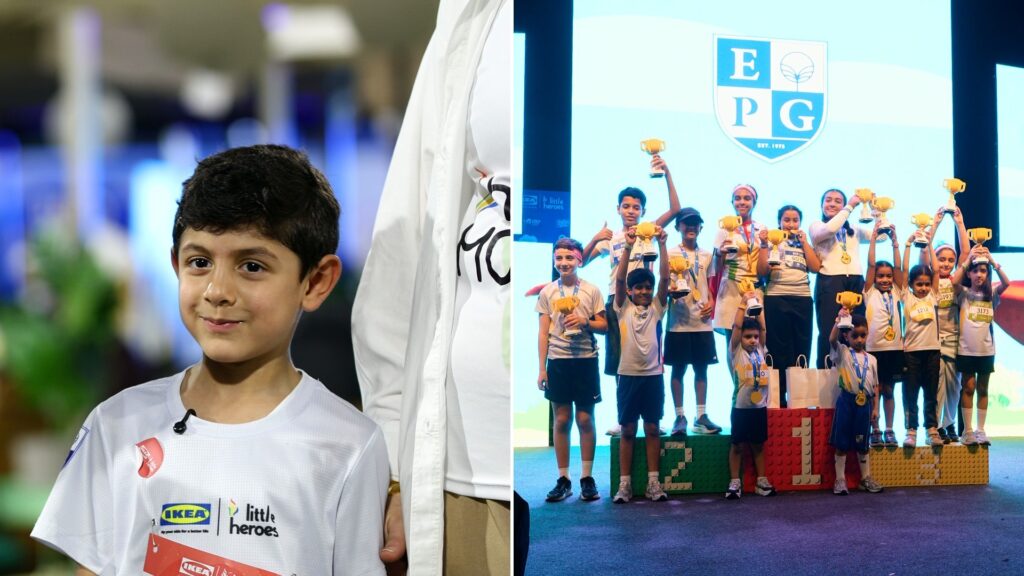
At Little Heroes, organised by Suffix and powered by IKEA, Sulaiman Erzouqi returned to the event where he discovered fencing. His story, and the families trying new activities around him, showed what can follow a child’s first opportunity to play.
Sulaiman Erzouqi returned to Little Heroes with a favourite sport and three fencing match wins to talk about. A year earlier, it had been the place where he first tried the sport.
Now, asked which activity he liked best, his answer came immediately: “Fencing.”
Speaking to Diwaniya Media on 30 October, Sulaiman and his mother described how an introduction at last year’s event became an interest he wanted to pursue. Around them, other children were discovering their own favourites, from running and basketball to the weightlifting station.
A first attempt that led to a club
His mother traced that decision to last year’s event.
“He started to play fencing after the Little Heroes last year event, and he said, ‘Mom, I really like this sport, I want to continue, I want to learn more about it,’” she told Diwaniya Media.
His mother said he had applied himself at the club, begun competing with other children and made clear progress.
She had tried fencing too, although it had not captured her interest in the same way. For her son, it became something he wanted to practise and improve at.
The sport he chose has a long Olympic history. Fencing has appeared at every modern Summer Olympic Games since Athens in 1896, according to Olympedia. For Sulaiman, however, the starting point was closer to home: an activity he tried and wanted to learn more about.
A sports ground full of possibilities
Organised by Suffix and powered by IKEA, the event brought children in Little Heroes T-shirts and race bibs together for races, football, basketball and a weightlifting station. On stage, winners lifted trophies between opportunities to try something new.
For one boy attending for the first time, the weightlifting station was a favourite. He was enthusiastic about the number of activities available and the chance to explore them.
Another first-time participant arrived with a more definite ambition: to run fast and win his race. His confidence offered a different picture of a first visit, with a child already eager to test himself.
One boy attended with his two sisters, naming basketball and volleyball among his favourites. Their family visit reflected the range of the programme, which gave siblings room to pursue different interests within the same outing.
The races also gave parents a chance to watch their children take part independently. One mother singled that out as something she particularly valued, while her son was keen to work his way through the activities.
“I love that the kids get to go by themselves and do something without the parent for once,” she said.
Fencing also featured in the first-day stage programme through a scheduled Down Syndrome Fencing Show. The sport that Sulaiman had discovered at Little Heroes was also being presented as an activity with a place for people with Down syndrome.
The programme extended beyond competition, with an opening warm-up, dance performance, IKEA Family Trivia, science and puppet shows, and a Little Heroes Parade. Football freestyle and taekwondo demonstrations were also scheduled, alongside the Hero Run, relay race and awards ceremony. The mix gave the day a family-festival format, with activities to watch and share as well as sports to try.
One question brought out the friendly rivalry within the families: who was better, the children or their parents?
The boy who had enjoyed weightlifting was confident that he had the advantage. “Obviously me,” he replied.
A younger participant gave the credit to his parents, while Sulaiman’s mother chose her son without hesitation, describing him as a champion.
For the parents, taking part in the afternoon also meant seeing what their children were willing to attempt. The interviews moved easily between playful comparisons and pride in the effort that had gone into learning something new.
From an afternoon to an ongoing interest
The wider importance of regular activity is well established. WHO recommends that children and adolescents aged 5–17 average at least 60 minutes a day of moderate-to-vigorous, mostly aerobic physical activity across the week. Vigorous activity and activities that strengthen muscles and bones should feature on at least three days a week.
For Sulaiman, the connection is personal. Last year, fencing was something to try. This year, it was the sport he named without hesitation, the club he had joined and the matches he was proud to have won.