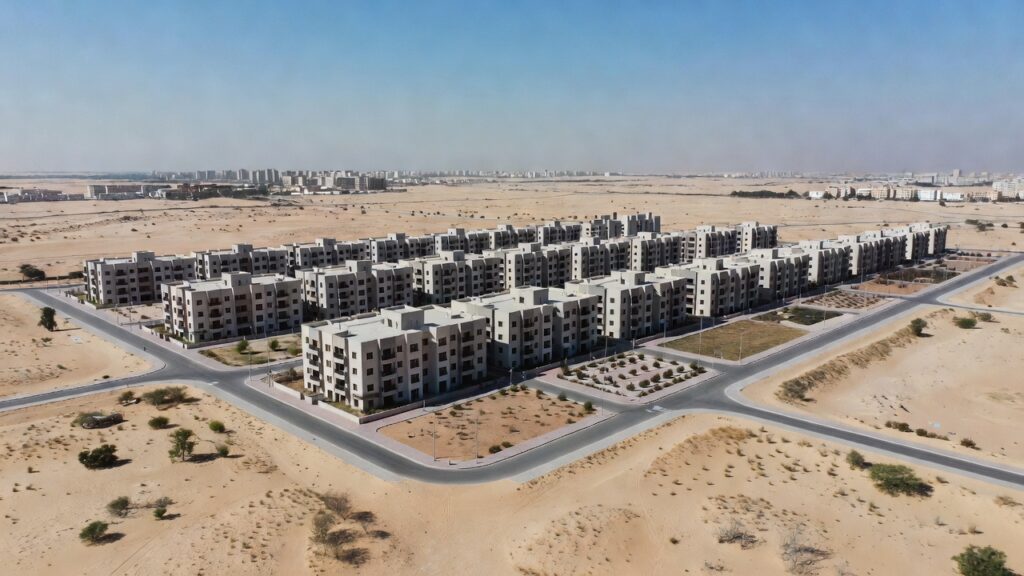
Sheikh Fahad Yousef Saud Al-Sabah announced on January 11 plans for new worker residential cities to replace those in Jleeb Al-Shuyoukh and Khaitan, where existing ones are at full capacity. During a visit to Wafra farms, the interior minister said the government headed by the Amir is prioritizing the relocation of workers from residential areas to new dedicated cities to be built by specialized companies.
According to the Arab Times, Al-Sabah affirmed the government’s keenness on comprehensive organizational solutions in line with the political leadership’s move to tackle the workers’ housing issue while supporting vital sectors. The solutions also encompass addressing shortcomings in agriculture and bolstering the Kuwaiti Farmers Union to aid local production. He indicated that the new cities would allow relocation of workers from existing overcrowded locations, particularly given the scale of expatriate populations in such districts.
The minister’s comments come as part of ongoing efforts to organize expatriate housing. A 2025 government strategy outlined the development of 12 new residential complexes outside family housing zones, with six workers’ cities designed to accommodate approximately 275,000 workers mainly in Jahra and Ahmadi governorates, according to MEP Middle East. Projects include a mega facility in West Shuaiba for 56,000 residents and an expansion in Shaddadiyah for 42,000, while current workers’ cities house only around 20,000 people.
Public Authority for Civil Information data places Jleeb Al-Shuyoukh’s population at about 274,000 as of 2023, of whom over 98 percent are expatriates. The district has been the focus of security campaigns targeting illegal and unsafe bachelor accommodations that pose risks to public health and safety. Gulf News reports from 2023 noted that low wages push many migrant workers into partitioned rooms, with up to five sharing a single space to manage high rents that consume around 30 percent of their income.
Al-Sabah reiterated the government’s commitment to fighting all forms of corruption in various sectors. He mentioned the withdrawal of farms in Jahra and Fahd Al-Ahmad, where the initiative benefited only one party while causing suffering to citizens. The minister stressed that the Kuwaiti Farmers Union should serve as an organizational body for farmers to support local production instead of seeking profits.
He questioned the logic of importing goods when local farms can supply directly, citing the aviation sector as an example where such purchases could be made. Al-Sabah called for monthly meetings among farmers to establish operational mechanisms, coordinate on challenges and boost agricultural production for greater sustainability. The interior minister added that several ideas are being developed to organize the sector more effectively.
Al-Sabah emphasized that implementing the desired reforms will take time. He noted the Amir’s commitment to protecting citizens’ interests and continuing the anti-corruption drive. The minister’s visit combined discussions on housing with agricultural support to enhance overall national production.