Muslim Jawish and Mishari Al-Mulaifi of Abdullah Al Salem University took first place in the Ball Collector category at the 17th Arab Robotics Championship in Alexandria, with a fully autonomous robot they designed, built and programmed in two months.
Two students from Abdullah Al Salem University have won first place in an Arab robotics competition category after developing a machine capable of collecting balls and sorting them by colour without manual control.
Muslim Jawish and Mishari Al-Mulaifi represented the Kuwait university at the 17th Arab Robotics Championship in Alexandria, Egypt. Working under the supervision of Rand Younes, the pair completed the robot’s design, construction and programming within two months, according to the university.
In its official announcement, published on October 21, the university said the championship brought together teams from different Arab universities. The students’ first-place finish was in the Ball Collector category, a specific competition within the wider championship.
The result puts a practical student engineering project at the centre of the story: a machine built to carry out a defined physical task, with its mechanical components and programming working together.
A two-month build with a clear task
The university described the robot as fully autonomous, able to gather balls and separate them according to colour. That distinction matters because the task goes beyond moving a machine by remote control. The robot must carry out the programmed sequence itself.
The announcement credits the students with all three main stages of development: designing the robot, building it and programming its operation. Those stages bring together different engineering demands, from the physical arrangement of components to the instructions governing the machine’s behaviour.
The university has not published the robot’s detailed specifications, component costs or competition scores. Its confirmed account establishes the development period, the robot’s main function, the students and supervisor involved, and the category result.
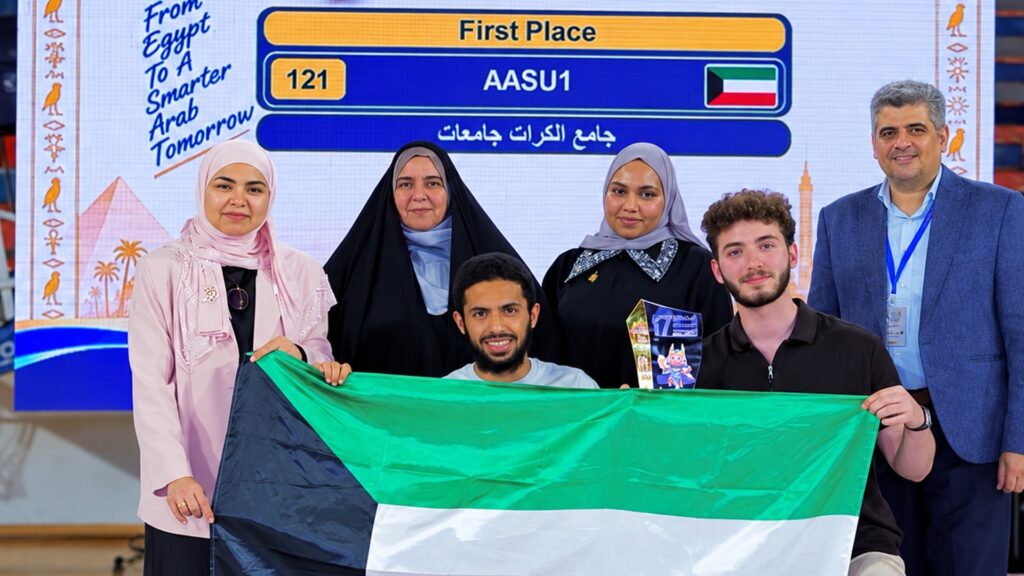
The award photograph shared with the announcement shows the team holding a Kuwait flag in front of a display identifying AASU1 as the first-place entry.
Robotics on the university’s study plan
The achievement comes at an institution with a dedicated academic pathway in robotics and mechatronics engineering.
Abdullah Al Salem University’s published study plan, updated in October 2025, includes programming, industrial electronics, digital systems and microcontrollers, instrumentation, sensors and actuators, and control systems analysis and design.
It also includes laboratory courses, computer-integrated manufacturing systems, engineering mechanisms for automation and a two-part capstone design project. Together, these subjects show how the university’s robotics curriculum connects software, electronics and mechanical engineering.
The championship announcement does not specify the two students’ degree programmes or year of study. However, their project offers a concrete example of the kind of integration that robotics education addresses: making physical hardware respond correctly to programmed instructions.
An earlier published programme document also lists elective subjects including autonomous mobile robots, machine vision and image processing, and machine learning for mechatronics systems. These are curriculum options, rather than confirmed technologies used in the winning robot.
Turning engineering knowledge into a working machine
The educational value of practical robotics projects extends beyond the final competition ranking. They create a setting in which students must connect concepts that are often taught separately.
A 2024 research paper on Macquarie University’s MecQaBot platform describes an autonomous robotics framework used by more than 240 undergraduate and postgraduate students over five years. Its authors identify sensing, programming, hardware-software integration and autonomy as central elements of that practical learning environment.
That research concerns a separate university and platform, but provides useful context for the engineering work involved in student-built robots. A functioning system requires more than a successful piece of code or a completed mechanical assembly in isolation.
For Jawish and Al-Mulaifi, the confirmed outcome is a first-place category finish following a two-month development effort. Their robot’s ability to collect and sort balls gave the project a clear purpose, and the Alexandria competition provided a setting in which that work could be assessed alongside entries from other Arab universities.