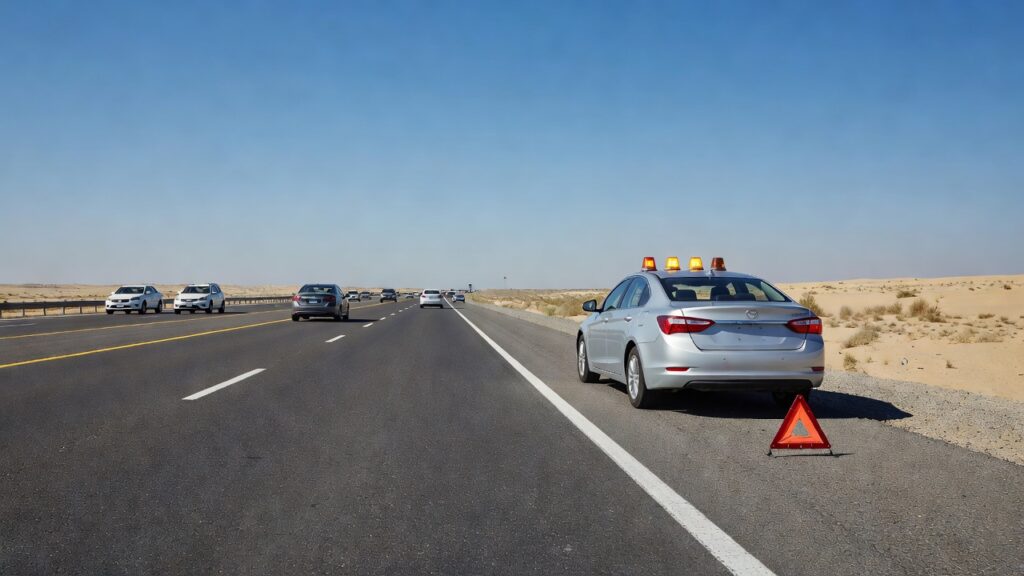
The General Traffic Department issued the safety guidelines as part of ongoing efforts to safeguard all road users and minimize secondary incidents that can arise from stranded vehicles. Motorists are advised to move their broken-down vehicle as far to the right as possible whenever feasible. They must immediately switch on hazard lights to signal distress to other drivers approaching from behind.
Drivers should then place a reflective warning triangle no less than 100 meters to the rear of the vehicle to provide adequate advance notice of the obstruction. The department instructed those involved to contact the unified emergency number 112 without delay while furnishing their precise location. Such information allows response teams to arrive swiftly and restore normal traffic movement with minimal disruption.
The General Traffic Department additionally called on all motorists to conduct routine vehicle maintenance checks including thorough inspections of tire condition and air pressure. These precautions gain added importance during the summer when high temperatures elevate risks of tire damage and sudden blowouts on Kuwaiti roads. Officials noted that preventive care helps avoid many breakdowns that otherwise contribute to congestion and hazards.
General Traffic Department figures show traffic accidents plunged 45 percent in the first half of 2025 from the prior year while fatalities decreased 34 percent after stricter traffic laws took effect. Colonel Fahad Al-Issa, who heads the traffic awareness department, linked the gains to better enforcement and greater public adherence to regulations. The new breakdown protocols build on that progress by addressing a frequent trigger of roadway disruptions.
A World Health Organization review placed the Eastern Mediterranean Region including Kuwait at a road traffic death rate of 16 per 100,000 people, ranking second highest worldwide. Kuwait has recorded hundreds of annual road deaths in past years according to historical health data, spurring sustained campaigns to improve compliance and infrastructure. The latest guidelines align with those wider initiatives aimed at cutting preventable incidents across the emirate’s highway network.
The department’s statement also serves as a reminder that proper preparation and prompt action protect both the stranded driver and surrounding traffic. Emergency responders rely on accurate location details and visible warnings to operate effectively in high-speed environments. Drivers who adhere to these steps play a direct role in sustaining the downward trend in serious collisions observed in recent official tallies.