Innovartism’s first graduates have turned their ideas into a short film. Their work brings creative education, public participation and future employment into the same conversation.
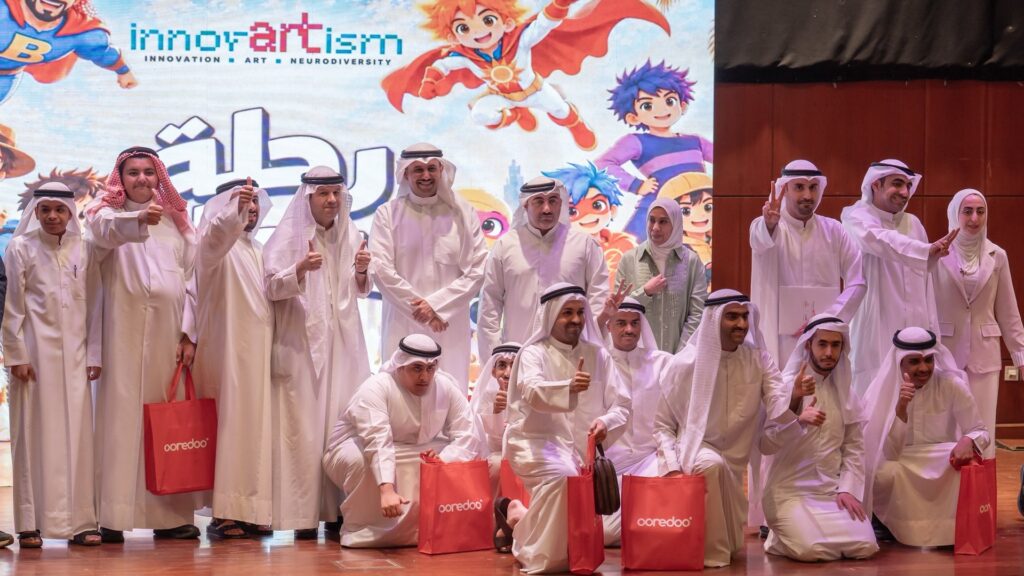
Fourteen participants with autism have completed a week of storytelling, character design and filmmaking in Kuwait, producing a short film that organisers plan to take to cinema audiences.
Their graduation on 1 November marked the completion of Innovartism’s first “Hero’s Journey” programme. According to KUNA’s coverage of the ceremony, the initiative is also working with private-sector partners on opportunities for some graduates.
The project connects creative training with a public audience. Writing a story, developing its characters and contributing to a production give participants a role in deciding what that audience sees. It is a practical expression of an ambition the organisers set out before the course began: to involve neurodivergent people in shaping creative programmes and the opportunities that follow them.
A week built around making
Warba Bank, one of the programme’s supporters, described a schedule running from 25 to 31 October, with five hours of training a day. Its announcement of the training programme set out a curriculum covering design thinking, art and content creation using artificial intelligence, alongside an ambition to support participants’ entry into private-sector work.
The combination brought several stages of creative production into the same course. Design thinking concerns how an idea is developed; art provides ways to express it; digital production introduces tools through which that work can be assembled and shared. The curriculum placed these activities within a defined period of practical training.
The bank said vocational and technical training opportunities were being provided free of charge. It also identified support from the United Nations Development Programme in supplying specialist trainers, connecting the local programme with additional professional expertise.
The studio involved brings experience in animation and visual storytelling. MB Vision Studios was founded by Manal Algharabally, whose professional biography describes a background in directing and psychology. The company identifies work with local creatives and collaboration with animation studios as part of its practice, connecting this training project to an existing production environment.
Designed with participants
Before the training began, Ooredoo Kuwait announced a strategic partnership with MB Vision Studios to launch Innovartism. In that partnership announcement, Algharabally described an approach shaped with the involvement of the people it was intended to serve.
“We believe participation begins with listening to those with lived experience and understanding their aspirations,” she said, explaining that participants should have a central role in shaping programmes and opportunities relevant to them.
The stated approach brought together creators, trainers, institutions and employers, with technology and professional development among its areas of focus. Ooredoo presented Innovartism as the first initiative in a broader collaboration with the studio.
Giving participants a role in programme design raises practical questions about which stories are developed, how sessions are taught and how work is presented. Those choices affect both the learning experience and the creative decisions that reach an audience.
That principle is reflected in UNESCO’s Framework for Culture and Arts Education, adopted in 2024. It calls for learners and communities to participate meaningfully in designing, delivering and evaluating arts education. Its approach encompasses community venues, workplaces and digital environments alongside schools.
Learning beyond the classroom
At Innovartism’s launch on 25 October, Kuwait Autism Center director-general Shaikha Al-Subaihi described the centre’s strategy in terms of education, rehabilitation and employment. Her remarks placed the initiative within a longer sequence of support, extending from learning into participation in working life.
The launch also brought in the National Council for Culture, Arts and Letters. Jaber Al-Qallaf, director of its Creative Economy Program, emphasised the importance of providing talented people with environments and tools in which to develop and express their abilities.
Algharabally’s plans for Innovartism included creative spaces, professional development, conferences and awareness campaigns directed towards families and organisations. The training course was therefore introduced as one component of a broader programme, with several routes through which participants’ work might reach institutions and the public.
UNESCO’s framework makes a comparable connection between access to arts education and the spaces in which culture is shared. It includes preparation for professional careers, access to cultural venues and inclusive opportunities to acquire digital skills. Disability is explicitly included among the grounds on which learners should not face exclusion.
The framework also treats access to technology as a matter of resources and learning opportunities. Applied to a project such as Innovartism, that directs attention to the teaching and support around the software, as well as the tools themselves.
Finding the next audience
For a participant considering further creative work, a completed production provides something concrete to discuss with a trainer, cultural organisation or potential employer. A story, character or sequence can become the starting point for a conversation about interests and further learning.
That is the connection Innovartism’s education and industry partners are seeking to develop. The first cohort’s work is intended for an awareness campaign, with online publication and cinema screenings planned. The next stage will bring the participants’ ideas to people beyond the programme itself.