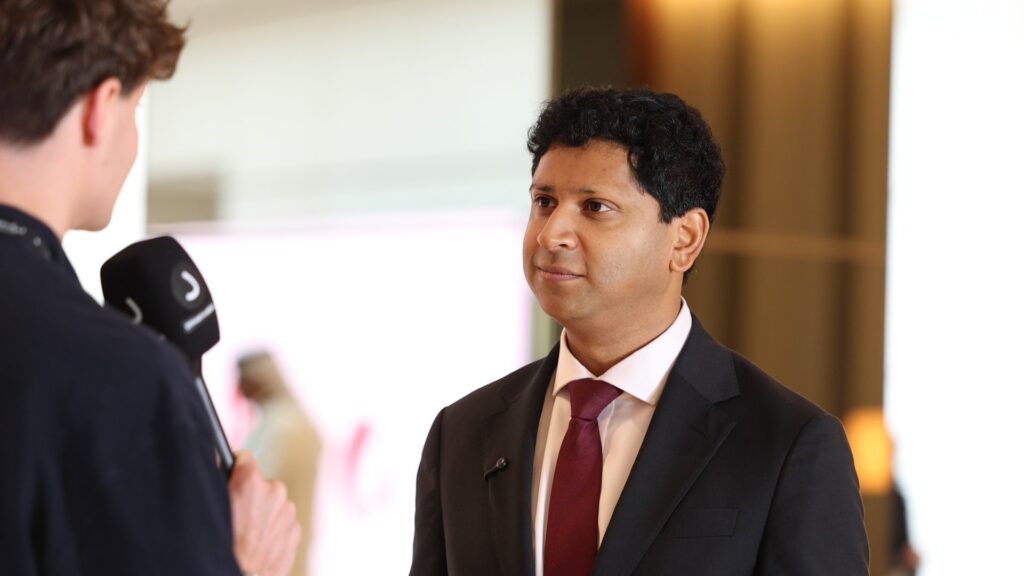
Qudsi Rasheed tells Diwaniya Media that overseas study offers young Kuwaitis a second education beyond the classroom, as both countries pursue closer educational cooperation and Britain targets £40 billion in annual education exports by 2030.
British Ambassador to Kuwait Qudsi Rasheed has identified education and innovation as priorities for cooperation between the two countries, arguing that opportunities for women to study and encounter new ideas are central to their economic participation.
Speaking to Diwaniya Media at the Women & the Economy conference in Kuwait on 17 October, Rasheed said more than 10,000 Kuwaiti students go to study in Britain each year. His emphasis was on what students gain alongside their academic qualifications: exposure to different cultures, perspectives and ways of working.
“I think for me the start is always education. Education is so important,” he said.
His comments come amid an active educational dialogue between the two governments. They also raise a wider question for families, universities and employers: how can the experience of studying abroad translate into opportunities when graduates enter working life?
A second education beyond the classroom
Rasheed described a recent meeting with a woman he identified as the first Kuwaiti woman to study in the UK. According to his account, she travelled there in the 1950s after her father sent her abroad, studying first in London and then in Edinburgh.
What stayed with him was her description of receiving two educations.
“She made the point, which was really interesting, as she got the education, but she also got a second education of seeing the world,” he said.
The ambassador did not name the woman during the interview. Her story served as an example of the broader experience he believes Britain can offer, particularly through encounters with people from different backgrounds.
“Britain for me is the centre of diversity. There are people from all sorts of backgrounds and cultures and knowledge,” he said.
Official figures illustrate the scale of that international student community. Higher Education Statistics Agency data for 2024/25 recorded 685,565 international students at UK higher education providers.
That is a measure of enrolled students across the academic year, rather than new arrivals. Rasheed’s separate figure for Kuwaitis was given during the interview without a statistical breakdown.
Education is already on the bilateral agenda
The ambassador’s comments follow discussions with Kuwait’s education authorities earlier this year.
On 22 April 2026, Kuwait’s Ministry of Education reported that Education Minister Sayed Jalal Al-Tabtabaei had received Rasheed alongside British Embassy officials and British Council Director Tony Skinner.
The meeting addressed expanding educational cooperation, exchanging expertise and improving education quality. The ministry described education as an important part of development and building human capabilities.
That discussion places Rasheed’s conference remarks within an existing government relationship. Cooperation can involve exchanges of expertise and institutional links as well as Kuwaitis travelling to British universities.
Britain also has a clear economic interest in developing those relationships. Its International Education Strategy 2026, published in January, sets an ambition to increase education exports to £40 billion annually by 2030.
The strategy covers the education sector broadly and seeks to attract international higher education students from a diverse range of countries. The £40 billion figure is a future target, not revenue already achieved.
For Kuwait, the corresponding question is what those relationships deliver in educational quality, useful expertise and the capabilities graduates bring into employment.
From qualifications to participation
The setting of the interview gave education a particular focus: women’s place in the economy.
Rasheed welcomed the conference’s atmosphere and the presence of men among its attendees. He said understanding the challenges women face should involve people beyond those directly experiencing them.
“There’s also lots of men here, and I think kind of having men understand the challenges that women face in economic participation is just as important as the other side of it as well,” he said.
External analysis points to the importance of conditions after education. In its 2024 assessment of Kuwait, the International Monetary Fund recommended encouraging greater female labour force participation by improving the working environment, including implementing childcare requirements in the private sector.
That recommendation concerns the practical ability to enter and remain in work. It adds an employment dimension to the ambassador’s emphasis on access to learning.
Taken together, the two perspectives suggest that qualifications and workplace conditions belong in the same discussion. An overseas education can expand someone’s knowledge and experience, while employment arrangements influence how readily those capabilities can be used.
Connecting universities, businesses and investors
Rasheed’s second priority was innovation. He referred to discussions at the conference about the speed of technological change and described the British government’s role in connecting educational institutions, companies, start-ups and venture capital funds.
There is an established research and business base behind that ambition. The World Intellectual Property Organization’s Global Innovation Index 2025 ranked the UK sixth globally, using measures that include research spending, venture capital activity, technology exports and intellectual property.
The ranking provides context for Britain’s innovation capabilities. Access to those capabilities through a particular university or partnership still depends on the arrangements involved.
Rasheed’s account identified several parties that would need to work together: institutions educating people, businesses developing ideas and investors financing their growth. He did not announce a new funding scheme or bilateral programme during the interview.
For Kuwait’s education relationship with Britain, the next question therefore extends beyond the number of students travelling abroad. It is how universities, employers and investors connect that experience with opportunities to undertake research, develop businesses and participate in the economy.