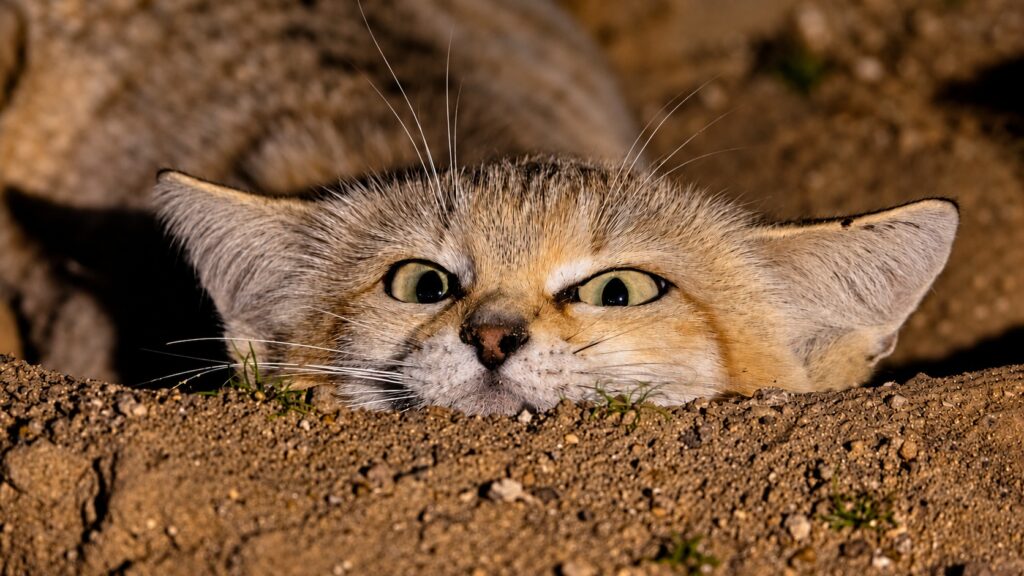
A sand cat at its burrow, a shrike holding a snake and brightly coloured migrating birds offer a closer look at the animals living in and passing through Kuwait.
The cat’s ears stretch almost the width of the photograph. Its chin rests just above the earth, with the darkness of a burrow behind it. In another frame, a grey bird grips a snake in its beak, reversing the encounter many people might expect.
Both appear in wildlife photographs by Ahmed Salem Ragab, known online as @boyahia. Alongside images of blue-cheeked bee-eaters perched together, they show different ways animals use Kuwait’s landscape: as somewhere to shelter, somewhere to hunt and somewhere to stop during a much longer journey.
The photographs also raise a straightforward question. How much of Kuwait’s wildlife goes unnoticed because people are looking in the wrong place, or at the wrong time? A desert cat that avoids daytime heat and a migrating bird present for only part of the year can occupy the same country while remaining absent from most residents’ daily experience.
A wild cat built for desert conditions
The sand cat’s resemblance to a domestic cat can obscure how specialised it is. Its broad head, low-set ears and sandy colouring belong to an animal adapted to dry environments across North Africa, the Arabian Peninsula and parts of Asia.
According to the Smithsonian’s National Zoo, sand cats are mainly active at night and around dawn and dusk. Burrows provide shelter from extreme temperatures, making the opening visible in Ragab’s photograph an important part of the animal’s habitat.
There are less visible adaptations, too. Dense hair and pads on the soles protect the feet against hot and cold surfaces and help the cat move across shifting sand. Its hearing helps it locate prey, including animals moving beneath the ground.
Small rodents form much of its diet, but sand cats also take reptiles, birds and insects. Snakes are among their prey. The cat in the photograph and the bird in the next image therefore have something in common beyond sharing a desert setting: both belong to species capable of hunting snakes.
The bird holding the snake
Ragab’s photograph posted on 27 April 2025 shows a great grey shrike with a snake looping down from its beak. The bird stands on sandy ground beside a low plant, with its black-and-white wings folded against its body.
In the accompanying Arabic description, the photographer identifies the shrike and explains the behaviour behind its “butcher bird” nickname. The name refers to its habit of fixing prey onto sharp points, including thorns, rather than simply swallowing every catch immediately.
The British Trust for Ornithology’s account of shrikes explains that several species use thorns both to hold prey while tearing it apart and to store food for later. A thorny shrub can therefore serve as more than a lookout or a place to rest.
The image captures one encounter, rather than every stage of the hunt. Even so, it makes an aspect of the bird’s behaviour immediately visible. A relatively small bird can be a predator of other vertebrates, and an ordinary-looking patch of vegetation can be part of its feeding routine.
Colourful visitors on a longer journey
The blue-cheeked bee-eaters introduce a different part of the story. Their green plumage, warm-coloured throats and long bills are conspicuous in a photograph of several birds sitting close together on a branch.
KuwaitBirds’ species account describes them as abundant passage migrants, widespread and often seen in flocks during spring and autumn. The account also records occasional summer presence and breeding in Kuwait.
Their appearance should therefore be understood in terms of season as well as location. A group photographed during migration does not necessarily represent birds that remain at that spot throughout the year.
The species feeds on insects, including locusts. Despite the emphasis on bees in its English name, its feeding habits connect it to a wider range of insect life.
For someone watching the same patch of land across several months, migration can change what is visible without the landscape itself appearing dramatically different. A branch that is empty on one visit may become a perch for passing birds on another.
Why Kuwait becomes a stopping point
Kuwait’s position at the northern end of the Gulf helps explain these arrivals. The country lies where several migration routes connecting Europe, Asia and Africa intersect, according to KuwaitBirds’ overview of migration.
Those movements are not one uniform journey. Some birds pass through on long-distance routes, while others arrive to spend the winter. Different species follow different pathways, and the site cautions against treating migration routes as precise, fixed corridors.
This distinction matters when looking at wildlife photographs. A species recorded in Kuwait may be resident, a regular seasonal visitor or an occasional arrival. Those categories tell different stories about how the animal uses the country.
Ragab’s photographs bring together desert wildlife and migrating birds, but their presence should not be mistaken for a single year-round community. The timing of an encounter is part of what makes it possible.
The habitat beyond the frame
Kuwait’s wildlife also depends on more than open sand. The country’s major bird habitats include desert and semi-desert, irrigated farmland, urban green spaces, wetlands and coastal areas.
Small differences within those environments can matter. Rocky features and uneven ground offer shelter; vegetation supplies cover and feeding opportunities; wetland areas support animals that could not use the surrounding dry landscape in the same way.
The photographs make those details worth noticing. The earth around the sand cat is shelter. The vegetation beside the shrike is part of a hunting environment. The bee-eaters’ perch is a temporary gathering place during a seasonal movement.
Seen together, the images offer a more specific picture of Kuwait’s wildlife than a list of species alone. They show animals using the country’s ground, plants and seasonal resources, sometimes in ways that are easy to miss until a photograph brings them into view.