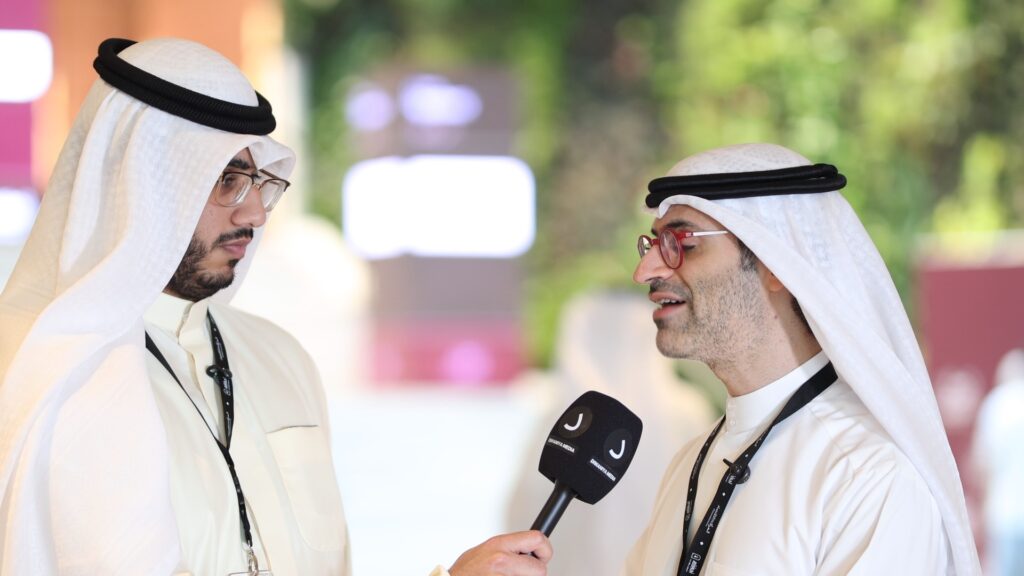
Speaking to Diwaniya Media, the Kuwait University academic highlighted women’s contributions across professional life and encouraged graduates to pursue ambitious careers, building on the country’s achievements in education and public service.
Kuwaiti academic Bader Al-Saif has highlighted the achievements of women across Kuwait’s professional landscape, describing their contributions as a source of national pride and encouraging the next generation to pursue opportunities across different fields.
Speaking to Diwaniya Media at the Women & the Economy conference, Lei Wa Lakom, in Kuwait on 17 October, the assistant professor of history at Kuwait University pointed to women’s growing professional roles and the importance of recognising the milestones already achieved.
“Our women are a source of pride,” he said.
His remarks connected the experiences of women established in their careers with the ambitions of those preparing to enter working life. Asked what advice he would offer recent graduates hoping to reach senior positions, his response was direct: “Look, the sky is the limit.”
A strong foundation in education
Women’s achievements at Kuwait University provide a substantial educational foundation for that ambition.
The university’s sustainability report for the 2023–2024 academic year states that women constituted 77% of its graduates. The figure relates specifically to Kuwait University and demonstrates the scale of female achievement within one of the country’s principal educational institutions.
For employers, those graduates represent a substantial source of knowledge and professional potential. For younger students, their achievements offer visible examples of women completing university education and preparing to contribute across different areas of national life.
Al-Saif said the ambition he encouraged among graduates was something he had already witnessed among women colleagues in several professional settings.
“I think that attitude itself can get you into many places,” he said.
He referred to his experience in academia, private business and public service, giving his comments a perspective that extended beyond a single occupation. His encouragement was directed towards people at the beginning of their careers, while drawing on the contribution of those already established.
“People, women, men, everyone on all walks of life should push the envelope, should not be willing to settle for less,” he said.
Recognising Kuwait’s professional milestones
Among the developments Al-Saif highlighted was women’s entry into Kuwait’s judiciary.
A study by Kuwait University legal scholar Fatima Alhewail, published in the Oñati Socio-Legal Series, documents the appointment of the country’s first eight female judges in 2020. The research also records women’s admission to the public prosecution in 2013, an important stage in their professional journey towards the bench.
These milestones form part of the history of women’s participation in Kuwait’s institutions. They also provide concrete examples for graduates considering the range of careers available to them.
Their significance extends beyond the individuals appointed. A professional milestone becomes part of the experience that subsequent generations can study, discuss and use when imagining their own futures.
Al-Saif’s remarks emphasised the value of recognising those achievements and building on them. His account of women’s contributions was rooted in the colleagues he had worked alongside and the institutions through which they had served.
That perspective gives the discussion a human dimension. National progress is reflected in professional appointments, but also in the daily work of researchers, educators, managers and public servants whose contributions accumulate over many years.
A conference focused on future opportunities
Al-Saif welcomed the conference as a timely opportunity to discuss women’s role in the economy and to bring practical ideas into wider public conversation.
“It’s a great event, very timely, and you can never stop talking about the role of women in all fields,” he said.
The areas he identified included workforce participation, pay, senior leadership and opportunities across sectors. Together, these subjects cover several stages of professional life, from entering employment to taking responsibility for the direction of an organisation.
His comments presented the conference as a place where those subjects could be considered in detail and translated into recommendations. He did not announce a final action plan or a specific programme, but described the value of bringing the discussion around concrete topics.
“The empowerment of women is ongoing, but it needs to be paired with specific actions based on each person’s abilities and work backgrounds,” he said.
For graduates, the emphasis on different sectors is particularly relevant. University education can lead towards research, business, public service or further professional study. Al-Saif’s encouragement left room for those different ambitions rather than prescribing one route to success.
Taking Kuwaiti women’s experiences into wider discussion
Al-Saif said women’s achievements in Kuwait also featured in conversations during his international travels.
“When they hear that I’m from Kuwait, Kuwaiti women come up in the conversation, and it’s something that I’m always proud of,” he said.
He linked that interest to his scholarship, including his work on gender and an edited volume examining women in the Gulf Cooperation Council.
The publisher’s listing for Women in the Gulf Cooperation Council: Negotiating Leadership, Power, and Change identifies Bader Mousa Al-Saif, Sumaiya Al-Wahaibi and Hanaa Almoaibed as its editors. The book examines women’s roles in the region’s public life across several fields.
In the interview, Al-Saif said his own priorities included amplifying women’s voices in the classroom and sharing research in discussions both within Kuwait and abroad.
That work offers another way to document professional achievement. Teaching and research can preserve the experiences behind major milestones and bring them to students who are making decisions about their own futures.
For Al-Saif, recognising achievement is an essential part of that task.
“We also need to celebrate the milestones,” he said.
His message to Kuwait’s next generation combines that recognition with encouragement: take pride in the achievements already made, pursue ambitious goals and contribute through the fields in which their abilities can make a difference.