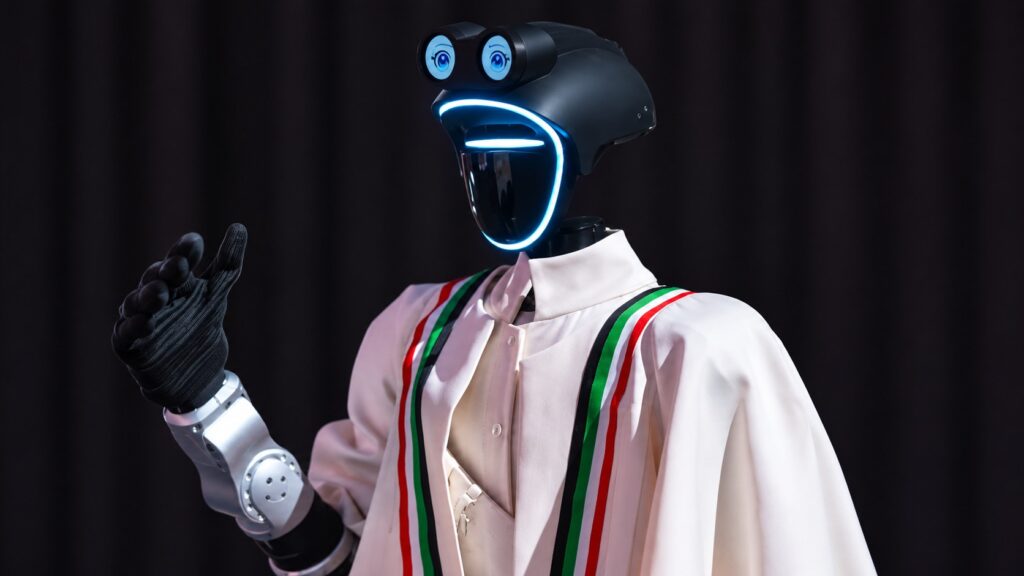
Kuwaiti fashion designer Bazza Alzouman is accustomed to thinking about how clothes look, move and feel on a person. Designing an outfit for a robot introduced a different set of considerations, from keeping its ports accessible to deciding how closely its appearance should resemble a human wearer.
Speaking to Diwaniya Media at the Women & the Economy conference in Kuwait, Alzouman described a commission that began with some hesitation and became an opportunity to explore both robotics and the use of artificial intelligence in her own creative process. Her initial instinct was that robots should remain visibly mechanical, but the prospect of encountering them in everyday surroundings led her to reconsider what clothing might contribute.
“If they’re going to be integrated into our lives, into our spaces, then they need to kind of integrate visually as well,” she said.
That thought became the basis of the project. Rather than approaching the outfit as another eveningwear design, Alzouman began by learning about the robot’s intended character, its physical requirements and the people who would interact with it.
Designing for the people around the robot
The robot had been assigned the identity of a young girl, which gave Alzouman a starting point but also required some restraint. She wanted its appearance to be welcoming without dressing it as though it were a child. Light beige colours offered the softer impression she was looking for, while the robot’s mechanical identity remained an important part of the design.
“We want it to feel welcoming and comfortable,” she explained, adding that the intention was for someone approaching it to feel at ease. At the same time, she was conscious of maintaining a distinction between a youthful character and a human child: “At the end of the day, it is a robot.”
The practical construction followed the same attention to how people would use and interact with the machine. Velcro openings at the sides and back allowed access to its ports, while a utility belt was included with possible assistance tasks in mind. Alzouman imagined someone being able to attach items to the belt when the robot came to help them, giving the garment a purpose beyond its appearance.
Together, those requirements made the assignment different from dressing a human client. Decisions about openings and accessories had to account for the hardware beneath the fabric, while choices about colour and presentation were directed towards the people encountering it. The outfit needed to accommodate both.
Bringing AI into the creative process
Alongside designing for a machine, Alzouman was also exploring how AI could contribute to the design itself. She said using the technology to help develop the outfit was one of the project’s concepts, describing the work as an experiment whose value extended beyond the finished garment.
“I don’t think in the end it’s really about the aesthetic of the final garment,” she said. Her interest was in exploring the place of technology within design and, more broadly, the place of machines within everyday life.
That experiment connects with a wider discussion in fashion about how much of the creative process can be supported by new digital tools. In a March 2023 analysis, McKinsey identified the development of design variations from sketches, fabrics and colour palettes as one potential application of generative AI. Its estimate that the technology could add between $150 billion and $275 billion to operating profits across apparel, fashion and luxury over the following three to five years reflected the scale of the industry’s interest, although it remained a projection.
For Alzouman, the question is how those possibilities fit into a practice built around making clothes. She studied fashion design at Parsons in New York and worked with Naeem Khan before establishing her label in Kuwait in 2014, according to her Oud Fashion Talks biography. Her brand’s website says design, sampling and production are managed from its Kuwait studio.
“I love the manual work and the creative process,” she said, describing that part of her work as something she holds tightly to. She nevertheless believes fashion requires an openness to change, and said she had no firm objection to using AI where it served a clear purpose.
“I just think it needs to be integrated in a way that makes sense, in line with my values, the brand values, and the needs of the world,” she said.
Client expectations also form part of that decision. Alzouman explained that providing a product means responding to what customers want, even as the methods available to designers evolve. Asked whether she could see herself using AI more extensively or taking on similar projects, she left the possibility open, describing her approach as still being in an exploratory phase.
Making work before feeling ready
The conversation about trying unfamiliar methods led into Alzouman’s advice for people beginning their careers in fashion. She encouraged young designers to enjoy making things and resist the tendency to judge their earliest work too harshly, particularly when that criticism prevents them from finishing or sharing it.
“Any creative is very critical to their own work, and I think you just need to get your work out there and then refine as you go,” she said.
Her advice placed experience ahead of the search for a perfect first collection. Producing work gives a designer something to reconsider and improve; waiting to feel completely ready can postpone that process. She drew on her own experience to make the point, noting that early collections need not remain a permanent expression of a designer’s work.