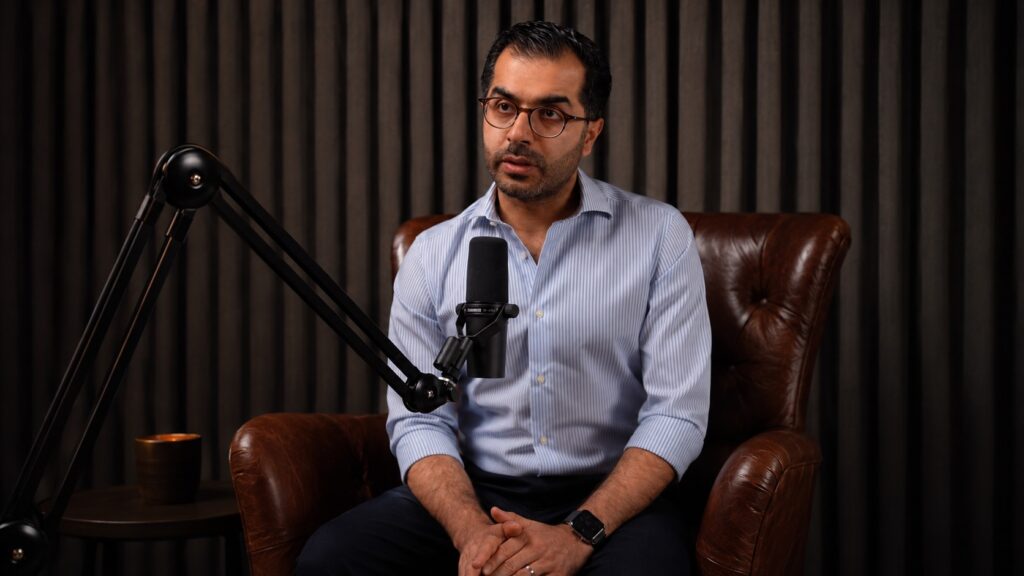
Patients ask about features, scarring and distortion before surgery. All three questions are about visibility rather than medical risk, and one technical variable determines the answer to each.
In a recent video on his Instagram account, Dr Husain AlQattan lists the three fears that come up before a facelift, in the order patients raise them.
The first is whether the features will change. His answer is that if the lift is carried on deep sutures they will not: the patient looks younger and rested but keeps her own features, including the natural hollows of the face rather than a filled, flattened version of them. The second is whether the incision will show. He ties it to the same variable, a deep suspension with no extra suture taken up in the skin, which leaves a wound that does not read and ears that sit normally. The third is the distortion patients call the joker face, the widened mouth and stretched centre. A deep lift, he says, leaves the nose and the lips exactly as they were.
Read the three again and something stands out. Not one is about medical risk. Nobody asks about the facial nerve, about haematoma, about anaesthesia or about how long the swelling lasts. All three are about detection. The patient is not frightened of the operation. She is frightened of it being visible afterwards.
Two different risk registers
That gap is the useful part of the video. The surgeon carries one risk register, built from nerve branches, flap vascularity and bleeding. The patient carries another, built from faces she has seen in public that went wrong in a specific and recognisable way. The consultation is where the two have to be reconciled, and they are not written in the same language.
His answer collapses all three fears into one technical variable, the plane the lift is carried in, and the logic is anatomical rather than cosmetic. Facial ageing is largely the descent of deep structures, the retaining ligaments and deep fat compartments, rather than a surplus of skin. A lift that releases and repositions those structures as a unit moves what has actually moved. A lift that takes its tension in the skin has to pull harder for the same effect, and lateral pull on skin is what produces both feared outcomes: a widened mouth, and an incision under permanent load that heals badly and shows.
So the three answers are one answer. Where the tension sits decides whether a face reads as rested or as operated on.
Why the question is being asked now
In the most recent published ISAPS Global Survey, covering 2024, total aesthetic procedures worldwide fell 4.8 percent while facelifts rose 7.4 percent to 737,028, up 75.9 percent on 2020. Face and head was the only region where surgical volumes grew. Botulinum toxin fell 17.4 percent in the same year and lip enhancement fell 23.9 percent. Patients are moving from the syringe back to the operating table, and the American Academy of Facial Plastic and Reconstructive Surgery built its 2025 member survey, published in February, around a shift away from visibly overdone results. The market has decided that looking untouched is the product. The three fears are that preference stated as questions.
What the evidence does and does not settle
The published evidence does not sit neatly on the patient’s side. A 2025 meta-analysis in Aesthetic Plastic Surgery, covering 21 studies and 2,896 patients, put satisfaction at 94.4 percent for deep plane techniques against 87.8 percent for SMAS, and the overall complication rate at 17.2 percent against 10.3 percent. A second review, in Annals of Plastic Surgery, found nerve injury rates similar between the two, most injuries temporary and permanent injury rare, but concluded that only one included study compared them directly and that the comparative data are too limited to declare one superior. It recommended individualised selection.
Higher satisfaction and higher complications are both in the record. The answer to all three fears is well supported on the question asked, and silent on the questions that were not. A patient reassured about her features, her scar and her mouth has been told the truth, and has not yet been told everything. Kuwaiti law assumes as much: Article 23 of Law No. 70 of 2020 requires written informed consent for cosmetic surgery supported by drawings, photographs and measurements, and defines the surgeon’s obligation as careful diligence rather than a promised result.