More than 2,000 robotic operations, cross-border procedures and new patient research trace the development of a Kuwaiti programme shaped by specialist training and international collaboration.
More than 2,000 robot-assisted operations have been performed at Kuwait’s Sheikh Sabah Al-Ahmad Kidney and Urology Centre. Behind that cumulative figure is a programme that now connects surgeons, operating theatres and patients across national borders.
Health Minister Dr Ahmad Al-Awadhi confirmed the milestone at the Kuwaiti Urological Association’s annual conference on 30 October. In the announcement reported by KUNA, he also highlighted 15 remote robotic procedures: 12 involving international connections and three linking locations within Kuwait.
These are distinct measures of the centre’s work. The larger total reflects its accumulated robotic surgical activity; the remote cases describe a smaller, newer application in which the surgeon can control instruments from another location. The centre’s robotic surgery experience dates to 2014, according to the newly published patient study.
The surgeon remains at the controls
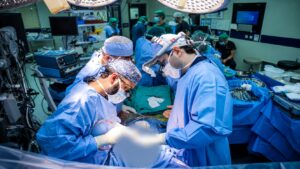
The term robotic surgery can obscure how much of the operation depends on human skill. The surgeon works at a console, viewing the surgical field and controlling instruments attached to mechanical arms beside the patient.
As the US Food and Drug Administration explains, these systems use computer and software technology to translate a surgeon’s movements into instrument movements. They require direct human control. Their use includes procedures carried out through small incisions, with a camera providing a view inside the body.
That distinction also explains the importance of training. Operating a robotic system involves learning its controls and understanding how its instruments behave during a procedure. The FDA identifies training for surgeons and other surgical staff as part of appropriate use. A hospital’s experience therefore rests with the people using and supporting the equipment, as well as with the equipment itself.
The training behind the technology
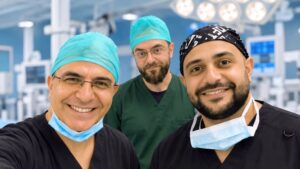
Dr Saad Aldousari, chairman of the centre’s Department of Surgery, has a career that connects Kuwait’s clinical practice with several international training institutions.
His 2026 professional biography records a medical degree from the Royal College of Surgeons in Ireland in 2003, completion of urology residency at McGill University in 2011, and a fellowship in urologic oncology at MD Anderson Cancer Center in 2013. He also holds academic appointments at Kuwait University and MD Anderson.
His work in Kuwait has included responsibility for examining and training future urologists. He headed the urology faculty and residency programme from 2019 to 2024 and was appointed director of the Kuwait Robotic Urology Fellowship Program in 2026.
Those roles give the centre’s surgical activity an educational dimension. The same career spans treating patients, supervising specialist training and developing a dedicated robotic urology fellowship. For a programme using complex technology, that connection between operating and teaching is a practical part of maintaining expertise across successive groups of clinicians.
Operating across borders
The centre began remote robotic surgery in December 2024. A KUNA account published by the Federation of Arab News Agencies provides a more detailed picture of the international connections: eight procedures from Shanghai, two from Strasbourg, and one each from Muscat and Padua.
The patients remained in Kuwait, with a medical team present alongside them. That arrangement is central to understanding the achievement. The distance separated the operating surgeon from the patient, while direct care continued inside the centre.
The account also describes collaboration within Kuwait. In November 2025, teams at Farwaniya Hospital and the urology centre worked on a patient requiring removal of the gallbladder and left kidney. The gallbladder procedure was performed remotely from Farwaniya, followed by kidney surgery by the centre’s team.
These cases show two applications of the same approach: connecting an operating theatre with expertise abroad, and coordinating specialist work between hospitals within Kuwait.
Learning together in the operating theatre
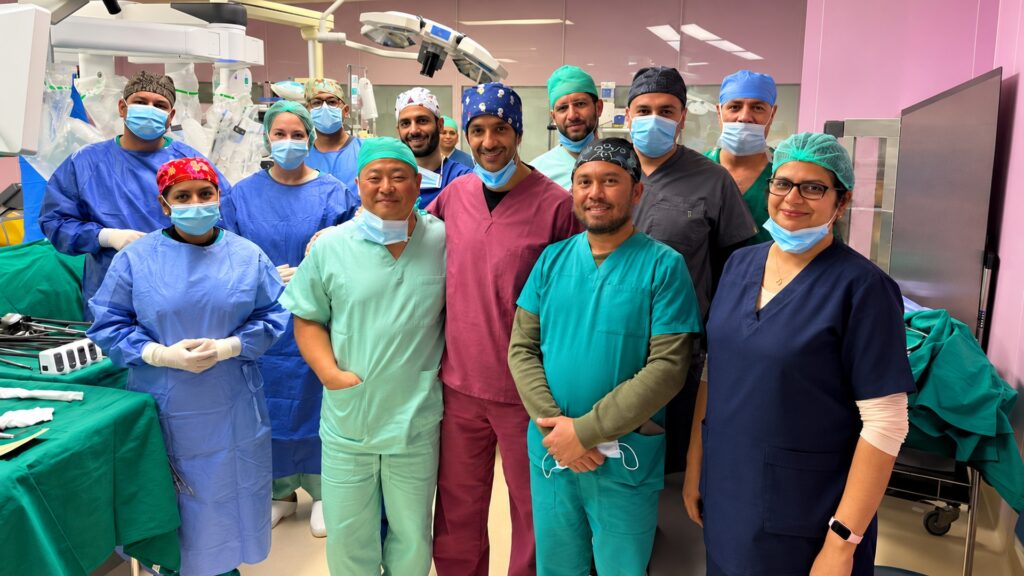
International collaboration also takes place with visiting surgeons physically present at the centre.
Dr Daniel Eun, a visiting robotic urologic surgeon, described his third trip to operate and teach there in a public account of his work with Aldousari and colleagues. His account included reconstructive surgery and experience using the Toumai robotic platform.
Eun described a complex operation in December 2024 that used the appendix to reconstruct an injured ureter, the tube carrying urine from the kidney to the bladder. He also discussed performing a robotic pyeloplasty, a procedure addressing obstruction where the kidney drains into the ureter.
The examples show the clinical detail behind a visiting-surgeon programme. The work involved particular reconstructive problems, the use of different surgical systems and opportunities to operate and teach together. It adds another dimension to the centre’s international connections, alongside cases in which surgeons and patients are separated by distance.
What patients make of the distance
The programme is also generating research about how patients experience this form of care.
A study published in Therapeutic Advances in Urology on 17 October compared 41 patients who underwent local robotic surgery with 10 who underwent robotic telesurgery at a Kuwaiti tertiary urology centre. Its authors included Aldousari, Ahmad Almarzouq, Ali J. Buabbas, Ahmad T. Al-Sultan, Abdulrahman Almazeedi and Basmah Bahbahani.
Satisfaction was high in both groups, with no statistically significant difference in satisfaction with the surgical procedure. Most patients in the remote group expressed confidence in the technology and willingness to undergo it again.
The findings are preliminary: the remote group was small, and the research examined patients’ reported experience rather than establishing that the approaches produce identical clinical outcomes.
That makes the study a useful addition to the operational milestones. Kuwait’s clinicians are documenting how patients respond to surgery across distance, as well as demonstrating that it can be performed. The authors call for larger studies to test those findings.