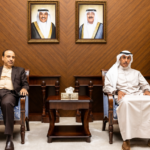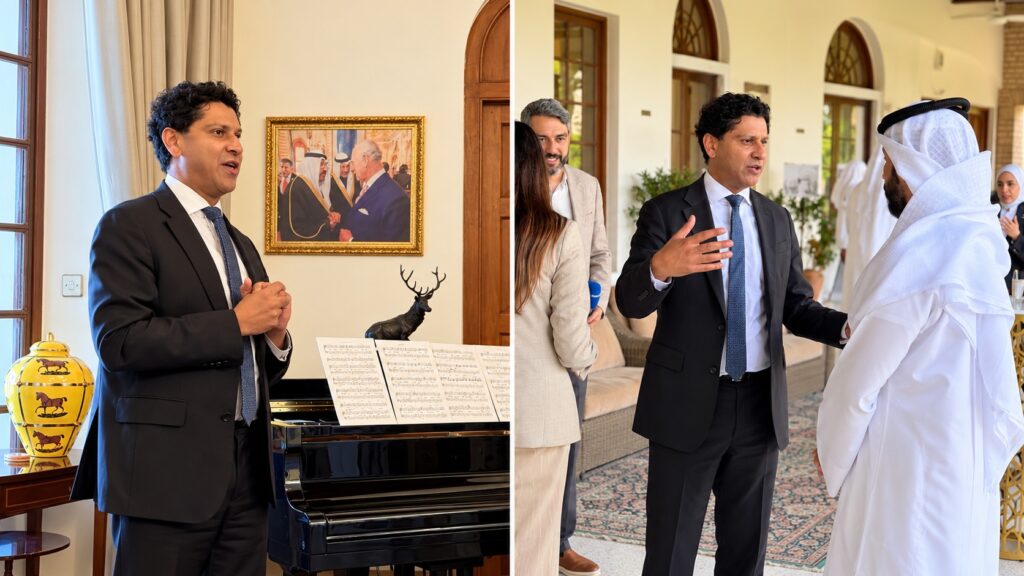
At a breakfast bringing together Kuwait’s media community, British Ambassador Qudsi Rasheed spoke about the country’s openness, the value of its storytellers and the importance of listening. His remarks offered a personal perspective on a friendship sustained through wartime solidarity, education and generations of exchange.
When British Ambassador Qudsi Rasheed was asked what had most inspired him about Kuwait, he began with the welcome.
“I think the openness of Kuwait is something really, really special,” he told Diwaniya Media.
He spoke about diwaniyas and the tradition of opening homes to visitors, then described something broader: a willingness to travel, encounter different cultures and share experiences. For Rasheed, hospitality was an expression of a country comfortable engaging with the world.
That appreciation helped explain the thinking behind a media breakfast bringing together people who report on, document and interpret Kuwait. The gathering reflected his interest in a media community that includes established journalists, bloggers, podcasters and creators exploring the country’s history, culture and architecture.
It also gave a human focus to the embassy’s work. Britain’s relationship with Kuwait is conducted through ministerial meetings and formal agreements, but Rasheed’s comments centred on the people whose knowledge and experiences give that relationship substance.
Kuwait’s stories, in many voices
Explaining the inspiration for the breakfast, Rasheed described a media landscape that had long fascinated the embassy.
He recognised the contribution of Kuwait’s traditional media and journalists who had been reporting for decades. Alongside that established community, he pointed to newer voices covering a broad range of subjects, from news and entertainment to cultural history.
Architectural photography was one example that particularly interested him: people recording Kuwait’s buildings and helping audiences understand the history behind them.
“And we want to bring together a bit of a community,” he said.
There is a substantial audience for that work. DataReportal’s Digital 2026 Kuwait report estimated that 5 million people were using the internet in October 2025, equivalent to 99% of the population. It also recorded 4.44 million social-media user identities, although those identities do not necessarily represent separate individuals.
Within that connected environment, Rasheed described a role for the embassy that includes both explaining and learning. Communicating Britain’s policies and its engagement with Kuwait mattered, he said, but so did understanding what people were telling his team.
“As much as we are communicating, we need to listen.”
He credited the guests themselves with making that exchange valuable.
“And so many of the people that we had here today are telling stories, and are fantastic storytellers, and I know personally and my team, we’ve learned so much from them.”
A friendship tested under siege
The embassy’s own history contains a powerful story of remaining connected to Kuwait in its darkest months.
Following Iraq’s invasion in August 1990, British Ambassador Sir Michael Weston and his colleague Larry Banks stayed in the country as conditions deteriorated. Rasheed has recalled the hardship of that period, including surviving on canned food and filtered swimming-pool water.
Their continued presence was a practical commitment as well as a diplomatic statement. In Parliament on 8 November 1990, then foreign secretary Douglas Hurd explained that Weston and Banks remained because they could maintain communication and provide support to Britons still in Kuwait.
In the same statement, Hurd acknowledged the Kuwaitis who were helping people in hiding at enormous personal risk. The record captures solidarity moving in both directions: British diplomats holding their position, and Kuwaitis protecting others while enduring the occupation themselves.
Weston and Banks eventually departed in December 1990, before liberation the following February. A contemporary Reuters report described how they barricaded the embassy’s doors from inside and left through a first-floor window using a ladder. Banks had grown vegetables and dug wells in the garden to help sustain them.
“I did not want to leave at all. I wanted to stay till the legitimate Kuwaiti government is restored,” Weston said.
That episode gives the language of friendship a concrete history. It records the decisions people made when remaining in Kuwait carried real hardship, and when maintaining contact could offer reassurance to those still there.
The next generation of the partnership
Today, the relationship is being renewed through education, professional training and cooperation that reaches into people’s working lives.
At Queen Mary University of London, 250 Kuwaiti students were enrolled in the 2025/26 academic year, the university’s largest Kuwaiti intake. Most were studying within its Faculty of Medicine and Dentistry.
The university’s partnership with Kuwait was recognised when the Kuwaiti Cultural Office honoured Professor Sir Mark Caulfield for his contribution to academic cooperation. The recognition connected a diplomatic anniversary with something tangible: Kuwaiti students developing expertise in British classrooms, laboratories and clinical settings.
Education remains an active priority. Kuwait’s Ministry of Education reported that Rasheed met Education Minister Sayed Jalal Al-Tabtabaei on 22 October 2026, with both sides emphasising continued coordination and stronger educational cooperation.
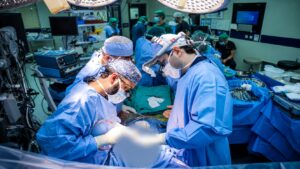
Healthcare is another area where the partnership has a direct public purpose. At the 22nd UK–Kuwait Joint Steering Group in October 2025, the two countries signed agreements covering healthcare cooperation and hydrographic surveying, alongside discussions on trade, investment, military training and development partnerships.
These are distinct areas of work, but each depends on sustained relationships between people and institutions. Students, educators, clinicians and specialists give continuity to a partnership that successive ambassadors inherit and help develop.
An openness experienced personally
At the breakfast, Rasheed returned to the everyday encounters through which he was coming to know Kuwait.
Diwaniya culture was the obvious example, he said, but the welcome extended beyond the gathering itself. He described openness to foreign cultures, travel and food as part of a wider outlook he had experienced in the country.
His interest in Kuwait’s storytellers followed naturally from that observation. A journalist, a podcaster or someone photographing an old building can offer a perspective that helps an embassy understand the society around it. Rasheed said those encounters were already teaching him and his colleagues.
For the guests, the breakfast provided an opportunity to speak directly with the ambassador. For Rasheed, it brought together people whose work was shaping his own understanding of Kuwait.
“And that openness really is part of the fabric of what I have experienced in Kuwait.”