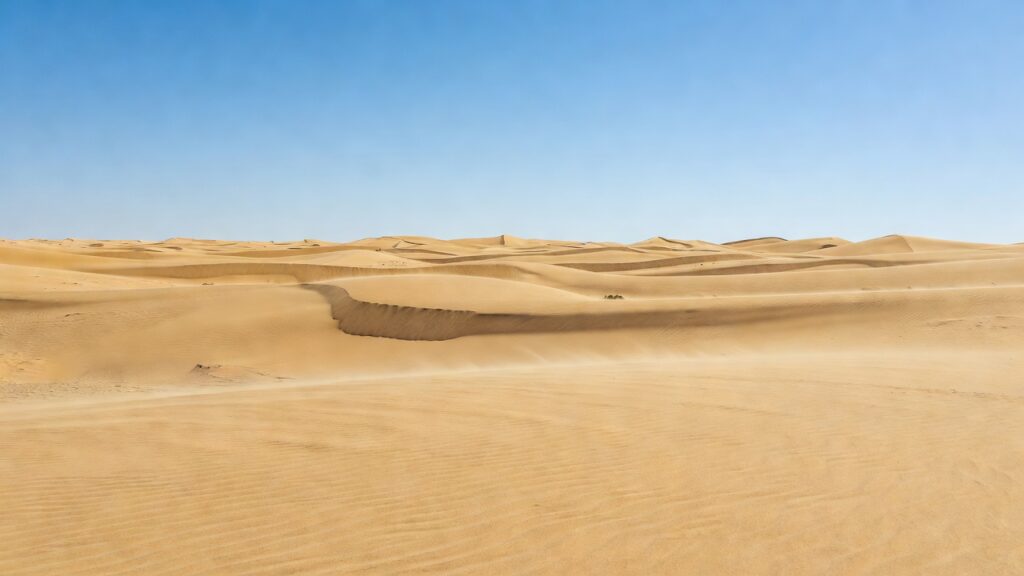
Kuwait’s Meteorological Department said dust conditions are expected to gradually improve from Monday night as northwesterly winds weaken and horizontal visibility increases. Acting Director Darrar Al-Ali told the Kuwait News Agency that Kuwait was affected on Monday by an extension of a surface low-pressure system accompanied by an extremely hot air mass. The system brought light to moderate northwesterly winds that occasionally intensified, reaching speeds of 15 to 55 kilometers per hour.
The strong winds stirred up sand and dust, reducing horizontal visibility in some areas to below 1,000 meters, particularly in open and exposed locations, according to the department. Al-Ali noted that wind speeds will gradually decrease tonight, allowing dust levels to settle. He added that light to moderate northwesterly winds will continue, occasionally becoming active along coastal areas and contributing to high waves. The maximum temperature recorded on Monday reached 46 degrees Celsius.
For Tuesday, the Meteorological Department forecast extremely hot conditions during the day and hot to warm weather at night. Winds are expected to remain light to moderate from the northwest, occasionally becoming active, with speeds between 15 and 45 kilometers per hour, along with a possibility of dust in exposed areas. Temperatures are expected to range between 34 and 36 degrees Celsius at dawn, while daytime highs are forecast to reach between 47 and 49 degrees Celsius.
Kuwait Meteorological Department climate data shows that summer months frequently bring maximum temperatures ranging between 40 and 44 degrees Celsius on average, with recent observations from mid-July 2026 recording highs above 45 degrees Celsius. Such patterns align with the current low-pressure system affecting the region. The department’s summaries emphasize how these hot air masses contribute to the intensity of the seasonal weather.
Official records from the Kuwait Meteorological Department indicate that dust storms varied from one to 18 annually between 2014 and 2023, while blowing dust events ranged from 53 to 86 days in those years. Dust haze appeared far more frequently, exceeding 290 days in most years according to the same data. These figures illustrate the prevalence of dust in the country’s desert climate throughout the decade.
The Meteorological Department has issued comparable forecasts at multiple points in 2026 during similar weather systems, with Al-Ali providing updates to the Kuwait News Agency on wind speeds and visibility in each case. Monday’s briefing follows that established pattern of regular public notifications. Department monitoring focuses on changes in wind intensity and temperature thresholds to inform residents of evolving conditions.